Re:Money
Resizing a Ring in a High Gold Market? Where the Money Actually Goes at the Bench
Dated4 min read
What a jeweler's repair quote is made of, how laser welding changed which damage is fixable, and why the metal line on the invoice moved.
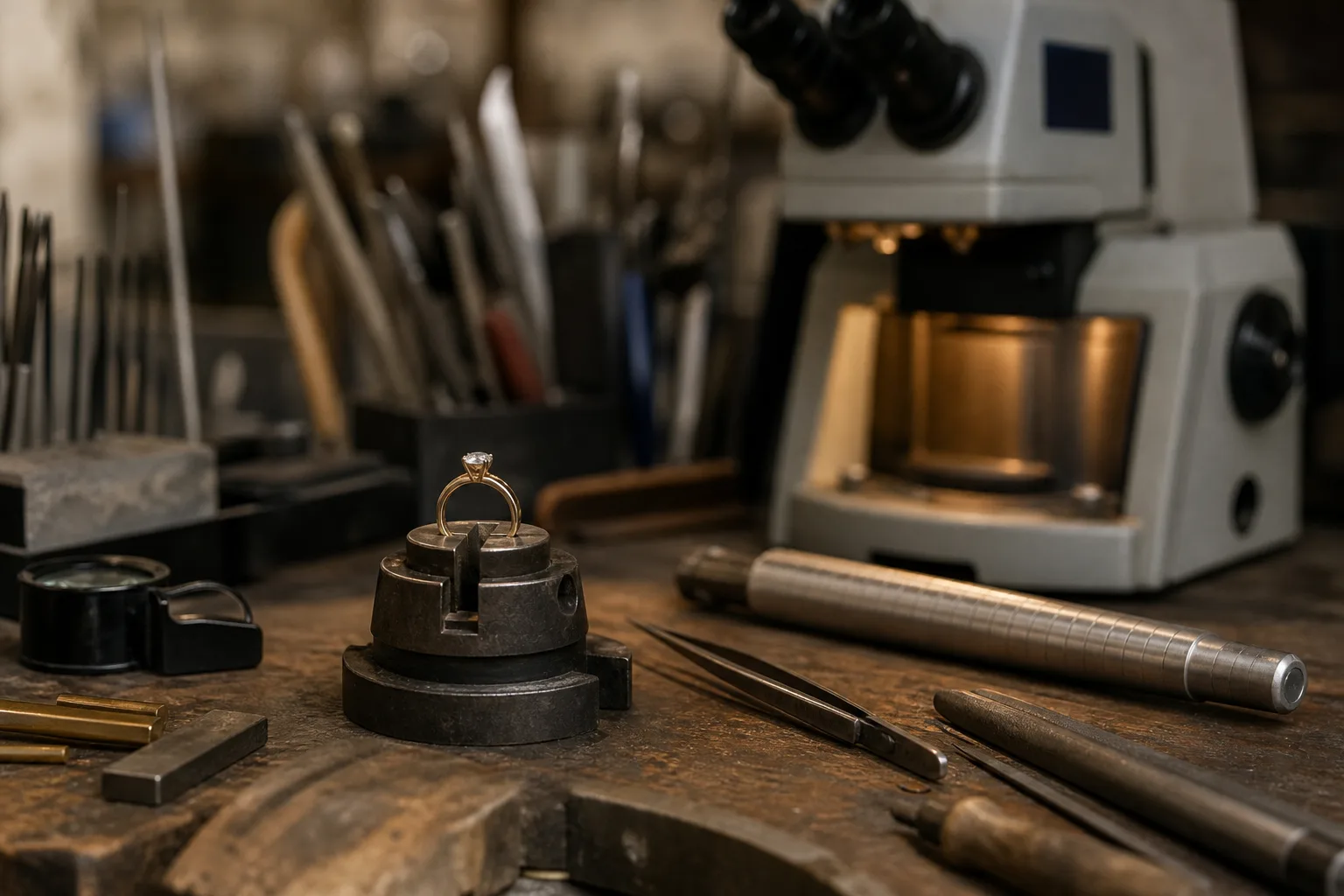
The envelope comes back from the shop with a number on it, and the number rarely matches what anyone guessed. A ring that needs to come down a size and a half, a chain that parted at the clasp, a prong that caught on a sweater and bent outward: three small jobs, three quotes, and no obvious logic connecting them. There is a logic. It is mostly bench hours, partly metal, and increasingly a question of what equipment the shop bought in the last several years, because the tool in the jeweler's hand decides which repairs are cheap, which are expensive, and which are now possible at all.
The quote is bench time first and metal second
On most repairs the metal is the smaller line. A sizing-down on a plain band removes a sliver of gold the jeweler weighs, credits or keeps, and the rest of the invoice is a person at a bench with a saw, a file, solder or a laser, and then the long part, which is finishing. Cutting and closing a shank takes minutes. Making the joint invisible, matching the brushed or high-polish surface, cleaning up the inside where the ring sits against skin, that takes the bulk of the time. When two shops quote the same job a hundred dollars apart, the gap is usually finishing standards and whether the stones come out first.
Up, down, and the stones that complicate both
Sizing down is the simpler direction. The shank is cut, a measured piece removed, the ends drawn together and joined, and the shape rounded on a mandrel. Sizing up adds metal, which means the shop supplies stock in the right karat and color, and color matching across white golds is its own small headache because alloys vary between manufacturers. Then the stones. A ring with a pave band, channel-set diamonds running halfway around, or a tension setting is not a shank job; it is a setting job with a sizing attached, and the price reflects the hours of resetting, tightening and re-polishing that follow. Eternity bands often cannot be sized at all and are remade.
What the laser welder changed, and why it matters to the bill
The meaningful shift at the bench over the past decade has been the spread of laser welding into ordinary neighborhood shops, not just trade houses. A torch heats the whole piece, which is why the old answer to a broken prong on a ring set with an emerald, an opal, a pearl or any heat-sensitive or treated stone was to unset everything first, do the work, then reset. A laser puts energy into a spot a fraction of a millimeter across, so the stone two millimeters away stays cool. Jobs that used to carry an hour of unsetting and resetting now sometimes carry none. Repairs once refused outright, such as retipping prongs on antique silver-topped mountings, are now routine.
The same machine changed repairs that involve mixed or thin metal. Worn shanks can be built up with added material rather than cut out and replaced. Hollow chains and lightweight tubing, which collapse under a torch, can be joined. Shops with a laser quote differently from shops without one, and that is worth asking about directly when you drop a piece off, because it determines whether your estimate includes an unsetting charge that another bench would not need to levy at all.
The metal line moved, and so did the plating line
Gold has run high, and that shows up in three places on a repair invoice: the stock used to size a ring up, the credit you receive for metal removed when a ring is sized down, and the trade-in math if you decide to remake rather than fix. Platinum work has always carried a premium because it is worked at higher temperatures with different solders and takes longer to finish. White gold brings a separate recurring cost, rhodium plating, which wears off at the contact points first and needs redoing every year or two on a daily-wear ring. That plating charge is small on its own and significant over a decade, and it is the line people forget when comparing white gold to platinum at purchase.
Two other things changed quietly. Experienced bench jewelers are retiring faster than they are being replaced, so shop labor rates have climbed and turnaround has lengthened, particularly in the weeks before the holidays. And more stores send work out rather than keeping a bench on site, which adds shipping, insurance and a markup, and means the person quoting you is not the person doing the work. The Federal Trade Commission oversees how precious metal content and karat marking are described to consumers, which is why a reputable shop will tell you in writing what alloy went into your ring.
Deciding what is worth fixing
The test is not sentiment, which always says fix it, and not replacement cost, which is a different number. It is whether the repair restores the piece to safe daily wear for a reasonable span of years. Retipping four prongs on a solitaire protects a stone worth many times the labor, and that is an easy call. Rebuilding a shank that has worn paper-thin in three places on a thin, mass-produced band usually is not, because the next worn spot is a season away. Ask for the piece's weak points in plain language, then decide once rather than annually.
Take a photograph of the piece before you hand it over, get the estimate in writing with the metal, the stone work and the finishing listed separately, and ask what happens to any gold removed. A good bench will answer all three without hesitating, and the answers tell you most of what you need to know about the shop.