New to a House? Build the Maintenance Schedule Around What Each Job Throws Away
Dated5 min read
Most first-year maintenance plans collapse at the disposal step. Anchoring the calendar to what a job leaves behind is what turns a list into a habit you keep.
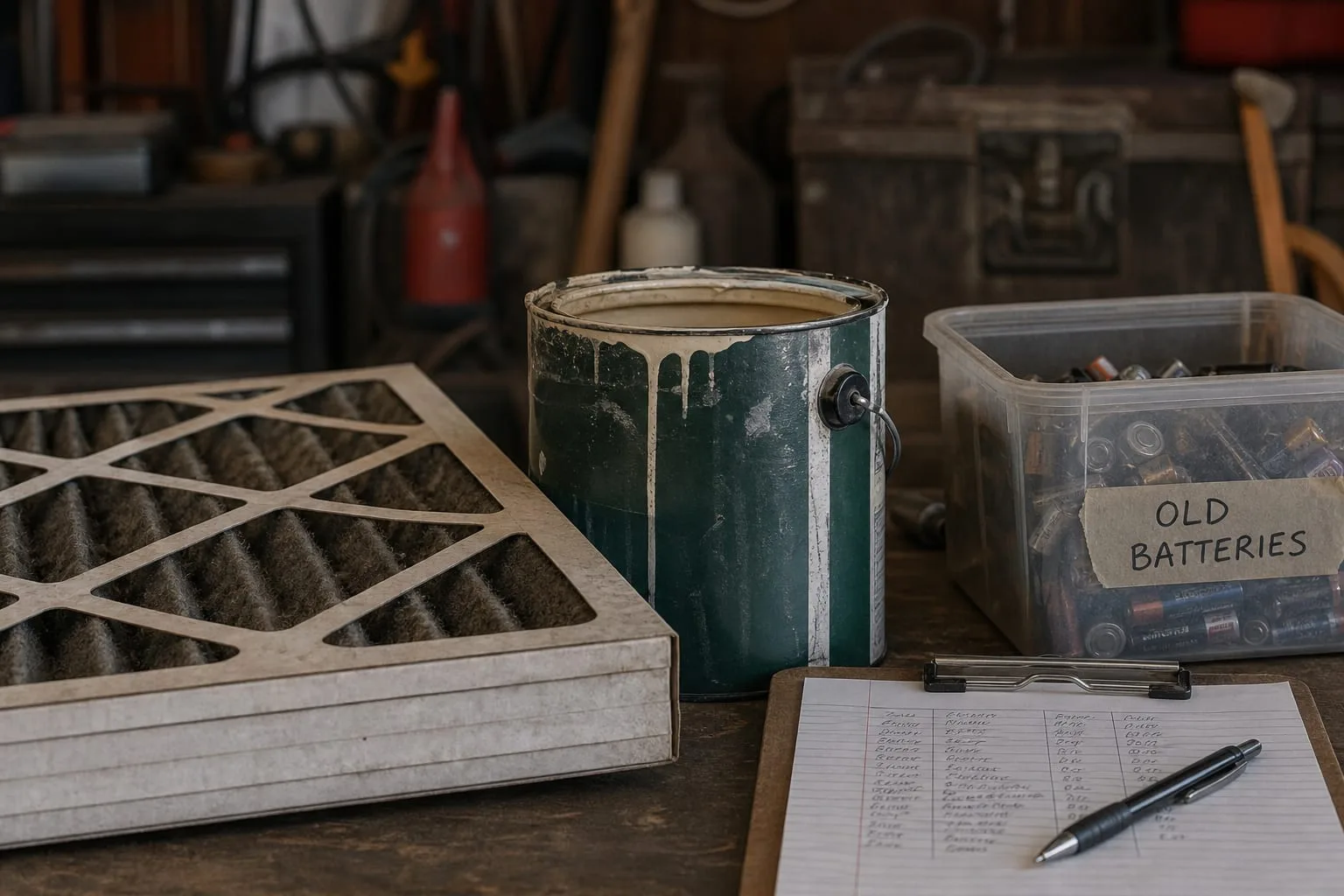
The maintenance schedule you download on your first weekend in the house is not the one you will keep. It fails in a specific place, and the place is almost never the task itself. Changing a furnace filter takes four minutes. Draining a few gallons off a water heater takes twenty. What stops people is the part nobody writes into the checklist: the old filter sitting in the hallway because it does not fit the kitchen can, the bucket of rusty sediment with nowhere obvious to go, the half can of deck stain that has been on the garage shelf through two summers. Judgement in upkeep begins with the residue.
Every task has a second half, and it is the half that gets skipped
Think of any routine job as two operations: the work, and the removal. The work is the part shown in the video, five minutes long, clean hands at the end. The removal is unphotographed. A gutter cleaning produces two or three contractor bags of wet shingle grit and rotted leaf mass that weigh far more than they look and cannot go out loose. A caulk job produces a cartridge with hardened residue, a wiped rag, and a nozzle. A paint touch-up produces a lined tray, a roller cover, and a can with an inch left in it that you are now responsible for indefinitely. If you have not decided in advance where each of those things ends up, the task quietly reschedules itself.
First-timers usually discover this in reverse order. They do the job, they enjoy having done it, and then a bag sits by the side door for eleven days. The memory that attaches to the task is not competence, it is the bag. Six months later the same task comes around and something in you resists it without saying why. That resistance is the whole reason downloaded schedules die. Build the removal into the plan and the resistance never forms.
Sort your outputs into four piles before you sort your tasks
There are really only four destinations for what house maintenance produces, and learning them in your first year does more for your judgement than memorizing intervals. The first is ordinary trash, which covers filters, roller covers, worn weatherstripping, and dust. The second is yard waste, which in most municipalities is collected separately and seasonally, in paper bags or a designated cart, and which will not be taken if you mix in soil, gravel, or the grit that washes off a roof. The third is bulk or scheduled pickup: the old water heater, the dead dehumidifier, the storm door you replaced. The fourth is household hazardous waste, and it is the one that catches people.
That fourth pile is narrower than people fear and wider than they guess. Oil-based paint, stain, thinner, most solvents and strippers, pool chemicals, pesticides, automotive fluids, and rechargeable and lithium batteries all belong to it. Latex paint often does not, provided it is fully dried out, and that difference alone changes how you buy paint. The Environmental Protection Agency is the federal body responsible for household hazardous waste rules, and the practical collection scheme sits with your county or municipal solid waste authority, which is where you look for dates and drop-off locations. Find that page in your first month, before you own anything that needs it.
Anchor the calendar to collection dates, not to the first of the month
A schedule built on abstract intervals asks you to generate motivation twelve times a year. A schedule built on disposal events borrows motivation from something already fixed. If your county runs a hazardous waste drop-off two Saturdays a year, those two dates become the deadline for anything solvent-based, and the small jobs that generate solvent waste naturally cluster in the weeks before them. If bulk pickup comes in April and October, the appliance you have been meaning to replace has a real date attached rather than a vague someday. Yard waste collection ending in late fall sets the outer limit for gutter work more honestly than any general rule about leaves.
Do the same with deliveries. A standing subscription for furnace filters, arriving quarterly, is not primarily a supply arrangement; it is a physical reminder that shows up at the door and takes up space until you act on it. The box on the floor does the work the phone alert failed to do. Pair the arrival with the removal, carry the old filter out to the can in the same trip, and the loop closes. That is the entire mechanism, and it survives busy months in a way that intentions do not.
Spend the first year logging, not scheduling
You cannot set sensible intervals for a house you have not lived in through four seasons. So do not try. Keep one page, paper or a note on the phone, and each time you replace a consumable write three things: what it was, the exact size or part number, and what you did with the old one. Filter dimensions, water filter cartridge model, smoke alarm battery type, the specific bulb, the brand of stain and the sheen. By the following spring you have a purchasing list that stops the ninety-minute hardware store errand that begins with holding up a dirty filter and squinting.
The same log tells you your real intervals. A filter that comes out gray at three months in a house with two dogs is not on a ninety-day cycle, it is on a sixty-day cycle, and now you know that from evidence rather than from a manufacturer's average. A gutter that fills by early November and again in a wet March is a two-visit gutter, not an annual one. This is what judgement actually consists of: local, observed frequencies replacing generic ones, backed by a page you wrote yourself.
Know what you substitute when the proper thing is not on the shelf
Supply gaps are ordinary, and part of deciding well is knowing which substitutions are fine and which are not. A pleated filter one MERV rating off from your usual is fine for a cycle. A slightly different white on a touch-up is fine on a closet wall and visible on a hallway you see in raking afternoon light. Silicone in place of paintable acrylic latex caulk is a mistake you will discover the next time you paint, because nothing sticks to it. Interior paint on an exterior threshold buys one season at most.
The waste rules move with the substitution. Choosing water-based products over solvent-based ones where performance allows keeps material out of the hazardous stream entirely, which means fewer trips tied to two Saturdays a year. Buying the smaller can, even at a worse unit price, means less leftover to store and less to dispose of. Those are disposal decisions made at the register, months before they become your problem, and making them there is the cheapest place to make them.
The schedule that lasts is short, tied to dates someone else already set, and written after a year of watching your own house rather than before. Start the log this week. The calendar will assemble itself from it.