Heading Into Cold Season? The Rules That Turn a Skipped Chore Into a Denied Claim
Dated5 min read
Cold weather does not create household faults so much as finish them, and warranties, policies and local codes all assume a household did certain things first.
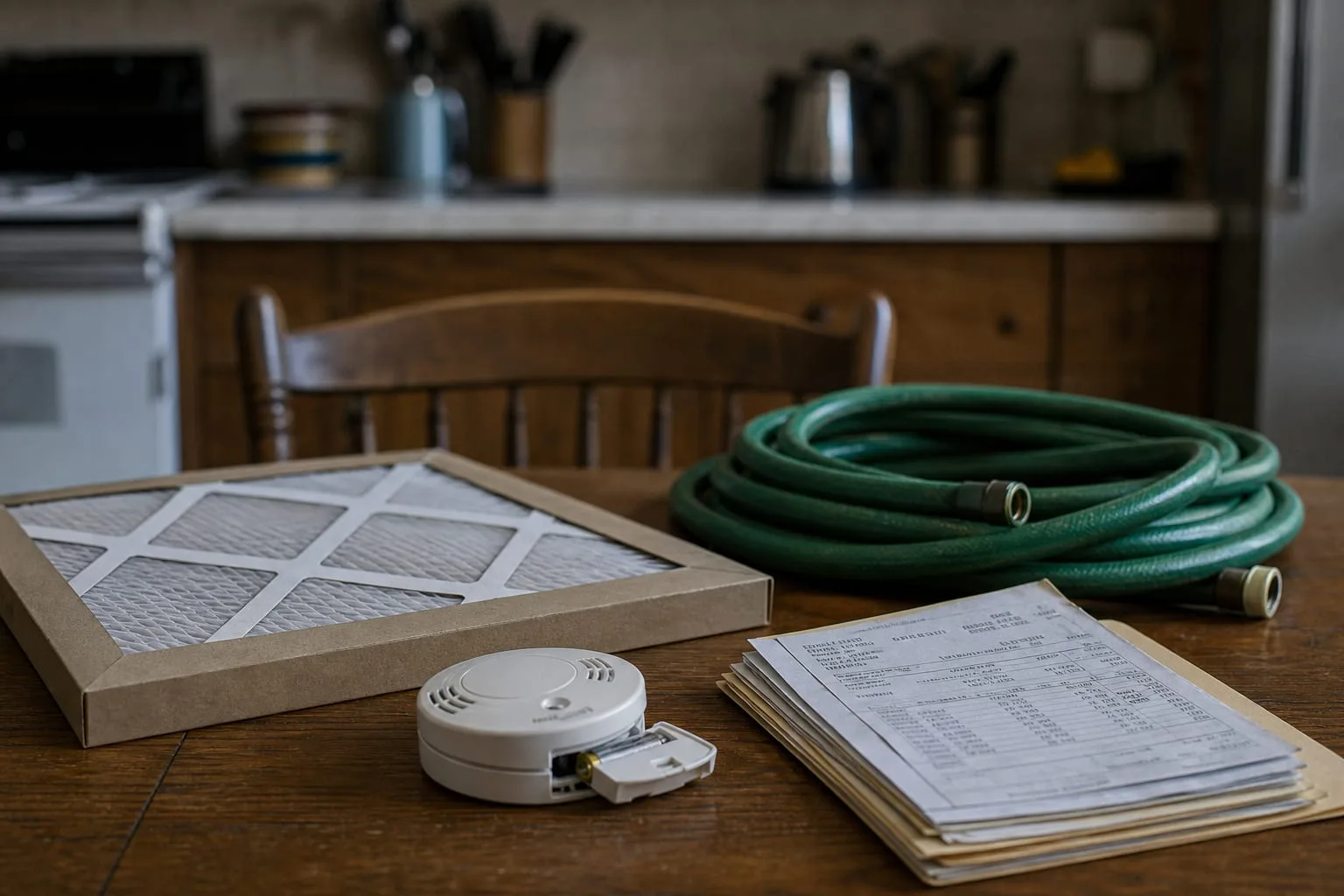
The first genuinely cold night of the year is the household's real inspection. Everything that was borderline in October gets tested at once: the gasket on the back door, the hose bib nobody disconnected, the furnace that ran fine on its two mild test cycles in September and now runs for nine hours straight. Nothing new breaks on that night. What breaks is whatever had already been quietly failing since spring, and cold weather simply finishes it. That is the part people underestimate about seasonal neglect, and it is also the part that warranties, insurance policies and local codes all quietly assume you understood.
What cold actually does to the materials in a house
Water expands when it freezes, which everyone knows, but the more useful fact is that rubber, plastic and sealant all stiffen well above freezing. A braided supply line with a cracking rubber core is fine in a warm laundry room and marginal in an unheated one. Caulk that shrank over a dry summer opens a hairline gap that wind drives water into. Flue gaskets harden, thermocouples corrode, and the flexible boot on a furnace inducer motor goes brittle. The season does not introduce faults so much as apply the load that reveals them, and it applies that load continuously for months rather than in short bursts.
That continuity is what makes the cost compound. A dripping outdoor spigot in July wastes water. The same spigot in January, left connected to a hose so the shutoff cannot drain, splits a pipe inside a wall cavity and does not announce itself until the thaw. A furnace running dirty in November costs a little more in gas each week, then wears a blower bearing, then takes out a control board. Each stage is affordable on its own. Stacked, over a single heating season, they turn a filter you forgot into a repair invoice with parts, labor and an emergency call fee.
The conditions inside a warranty that most households never read
Nearly every heating appliance sold with a ten or twenty year parts warranty carries maintenance conditions in the fine print, and they are not decorative. Common ones require professional installation by a licensed contractor, registration of the unit within a set window after installation, and annual servicing performed by a qualified technician. Some manufacturers also specify filter type and change interval, and a few void coverage on heat exchangers if the unit ran with restricted airflow. None of this is hidden, exactly. It arrives in a plastic bag taped to the cabinet on a day when three people are in the hallway and the house is full of dust.
What that means in practice is that the warranty is a documentation contract as much as a product promise. When a heat exchanger cracks in year seven, the manufacturer's dealer will ask for the registration and the service history, and a household that has both gets a part covered and pays labor. A household that has neither pays for everything. The service records do not need to be elaborate. Dated invoices from whoever did the work, kept in one folder, satisfy almost every claim of this kind, and they cost nothing beyond the discipline of filing the paper on the day it arrives.
What a homeowners policy expects of you between claims
Insurance is built around a distinction the industry states plainly: it covers sudden and accidental losses, not deterioration, wear or the consequences of failing to maintain a property. A pipe that bursts because a hose split is a loss. A pipe that leaked slowly for eight months behind a vanity, rotting the subfloor, tends to be read as neglect, and the payout shrinks or disappears accordingly. Most policies also carry a specific cold weather condition: coverage for freeze damage applies only if the household maintained heat in the building, or shut off the water supply and drained the system, during any period of vacancy.
That clause matters enormously to anyone who travels over the holidays, keeps a lake cabin, or drops the thermostat to fifty degrees to save money while the family is away for two weeks. The protection is real, and it is conditional, and the condition is a chore. Setting the thermostat no lower than the policy allows, opening cabinet doors under sinks on exterior walls, and knowing where the main shutoff is and that it actually turns are all small acts that keep the coverage you already pay for intact. A shutoff valve that has not been operated in six years frequently will not close when you need it to.
The rules that come from outside the insurance contract
Local building and fire codes carry their own seasonal obligations, and they attach to the occupant more often than people expect. Most jurisdictions require working smoke alarms and, where there is any fuel-burning appliance or an attached garage, carbon monoxide alarms on every level and near sleeping areas. The Consumer Product Safety Commission is the federal body responsible for hazards of this kind in consumer products, and combustion appliances are squarely within that world. Heating season is when carbon monoxide risk actually exists, because that is when the equipment runs, and it is also when a household closes every window it opened in June.
Renters have a parallel set of protections that work only if they are used in writing. Habitability standards in most states require a landlord to provide functioning heat, and the practical mechanism is a dated written notice describing the problem, followed by a reasonable period to repair. A text message counts more than a hallway conversation. Owners in a homeowners association face the mirror image: the association's documents usually assign gutters, roofs or exterior sealant to one party or the other, and the household that reads that allocation in October learns whose budget an ice dam belongs to before there is one.
Building a record that costs an afternoon and pays for years
The protections described above all depend on evidence, and evidence is cheap if you gather it while nothing is wrong. A photograph of the furnace data plate, the water heater serial number, the electrical panel with the door open, and the main water shutoff takes ten minutes with a phone and puts model numbers in your pocket for the next decade. Add the dated service invoices, the appliance registration confirmations, and a couple of wide shots of each room taken before the season starts, and you have most of what an adjuster, a manufacturer's dealer or a small claims judge would ask for.
Households that do this tend to discover a second benefit, which is that the record shortens arguments with contractors. When the technician says the unit is nine years old and has never been serviced, you can show that it was serviced in each of the last four Octobers and by whom. The conversation moves immediately to the actual fault. That is a meaningful saving in a season when every heating contractor within thirty miles is booked and diagnostic time is billed by the hour.
Pick a Saturday in early fall, disconnect the hoses, replace the filter, test the shutoff, press the buttons on the alarms, and file the receipts in the same place you filed last year's. It is a couple of hours of ordinary, slightly tedious work, and it puts the household on the side of every rule that will be applied later.