Re:Legal
Contractor Walked at Eighty Percent? How the Settle Decision Changed in Ten Years
Dated5 min read
A stalled kitchen job, one bad quartz seam, and the practical arithmetic of settling now versus the way the same argument ran a decade ago.
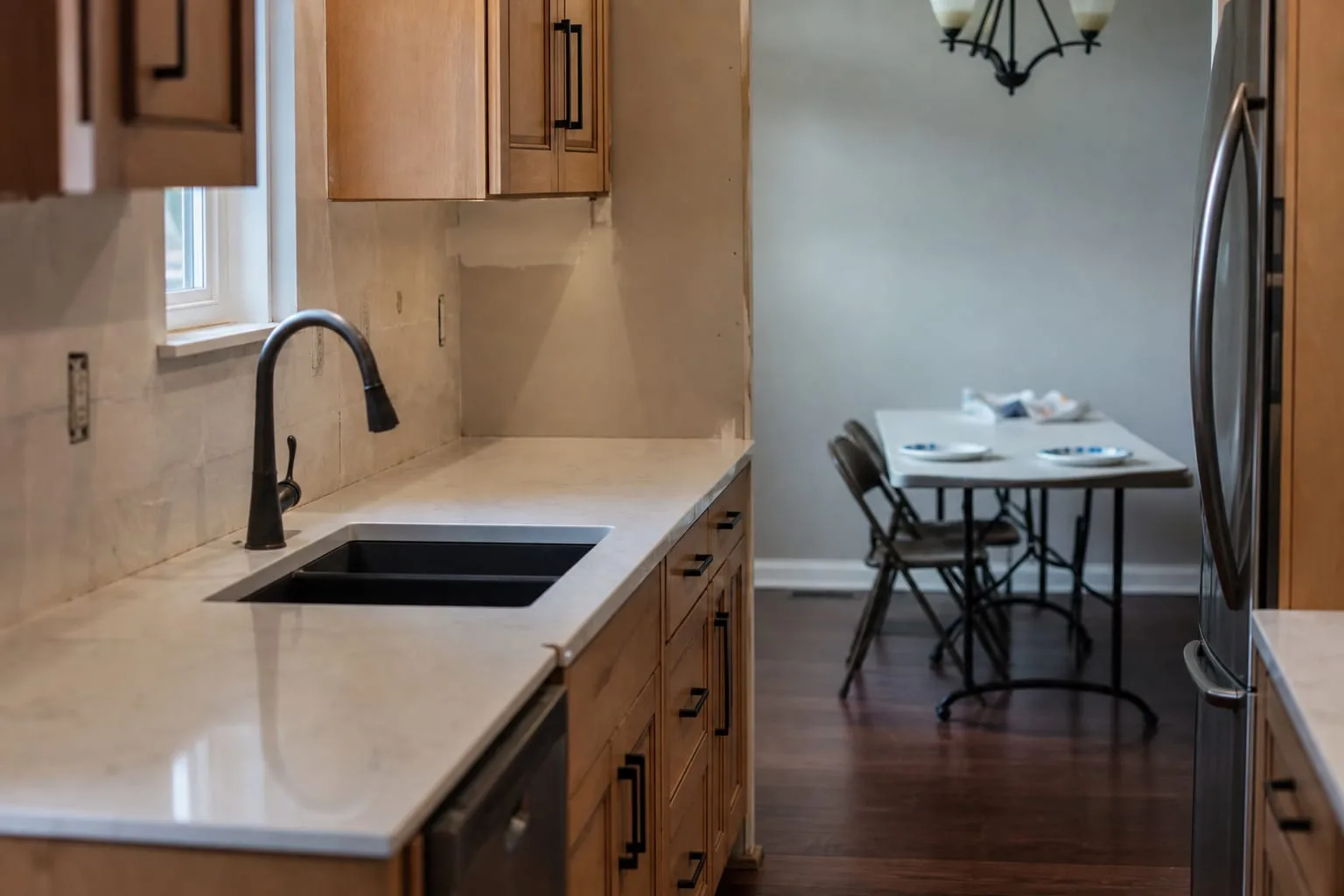
The job in question was a galley kitchen: fourteen linear feet of frameless boxes, a quartz top with one seam behind the sink, and a tile backsplash that never got started. The crew hung cabinets over four days, set the slab on a Tuesday, and then stopped answering. What was left was a seam you could catch a fingernail in, three doors out of alignment, no toe kick, and a household eating off a folding table in the dining room. The homeowner had paid seventy-eight percent of the contract. The question was not whether he was right. It was what being right was going to cost, and whether a check now beat a judgment later.
The narrow case, and the two numbers inside it
Strip the anger out and a stalled remodel resolves into two figures that have nothing to do with each other. The first is completion cost: what a second contractor charges to finish and correct, which here meant a seam grind and epoxy refill, four door adjustments, toe kick and shoe molding, and the backsplash from scratch. The second is the unpaid balance, the money still sitting in the homeowner's account. When completion cost is close to the balance, the dispute is largely theoretical and settles itself. When completion runs well past the balance, as it does whenever a slab is involved, there is a real gap, and the gap is the only thing worth arguing about.
He got two bids to finish. Both refused to warranty the countertop work of another shop, which is standard and not obstruction, and both quoted the seam repair as a separate line with a stated chance it would still read as a shadow. That uncertainty is the part that pushes people toward litigation and the part that makes litigation a poor instrument. A judge can award money. Nobody can order a seam to disappear. Understanding which of your problems are compensable and which are simply permanent is the first honest step in deciding what a settlement is worth.
What the file looks like now that it did not ten years ago
A decade back, the evidence in a case like this was a signed contract, a stack of canceled checks, and whatever the homeowner could remember about the phone calls. Recollection did most of the work, and recollection loses. What exists now is a different animal. The whole negotiation lives in a text thread with timestamps, including the message where the lead carpenter concedes the seam is off and promises to send the fabricator back. There are photographs taken daily with location and time embedded, a shared album from the designer, an emailed change order, and a payment record with a memo line. That thread turned the case from a credibility contest into a documentation exercise.
The practical effect on settling is direct and it cuts toward peace. When both sides can see the same admission in writing, the range of plausible outcomes narrows fast, and a contractor's attorney, if there is one, will price it accordingly. Ten years ago the honest advice was to expect a fight over what was said. Now the fight is over what the repair costs, which is a question two estimates can answer in a week. Cases with clean records settle earlier and closer to the real number, and the household gets its kitchen back sooner.
How you paid is now part of the leverage
The payment method has quietly become one of the most consequential choices in the whole project, and it barely registered as a decision a decade ago, when almost everyone wrote checks. A deposit and progress payments run on a credit card carry a dispute process with the issuer, with deadlines that are short and unforgiving but genuinely useful when a job stops mid-stream. Money sent through a bank transfer app is treated as cash and behaves like cash: once it lands, it is gone, and recovery runs through the courts rather than through a chargeback. The Federal Trade Commission is the agency responsible for consumer protection in transactions of this kind, and its remit is one reason card networks maintain formal dispute channels at all.
In this case, the deposit went on a card and the two progress payments went by check. That split mattered. The card portion gave a lever that produced a phone call from the contractor within days, after months of silence, which is often the entire point of pulling it. Homeowners planning a job now can build that leverage in advance simply by putting the deposit and at least one milestone on a card and accepting the processing fee as the price of an exit route. It is cheap insurance, and it changes the tone of every conversation that follows.
Counting the settlement in weeks, not just dollars
The part that decides most of these is the calendar. A family without a working kitchen is spending money every day on takeout, paper plates and a microwave on a laundry room shelf, and running a low-grade domestic tax on patience: dust in the hall closet, a refrigerator in the dining room, nobody having anyone over. Small claims in most states will hear a matter of this size, filing is now largely online where it once meant a trip to the clerk's window, and the wait to a hearing date is still measured in months. Multiply the months by what the household actually burns per week and the gap between demand and offer starts looking small.
He asked for the full completion cost, was offered roughly half, and took a figure a little above the midpoint on the condition it clear within ten days. The second contractor started the following week. That is not a defeat. Settling is a purchase, and what you buy is a finished kitchen in June rather than a hearing date in October with the same odds and worse dust.
Writing it down so it stays settled
A settlement that lives in a text thread is an invitation to a second argument, so put it on one page: the amount, the payment date, the method, a release of claims relating to this contract only, and a plain sentence saying neither party owes the other anything further. Say explicitly what happens to any lien rights and to the warranty on the work already installed. If the contractor wants a clause about online reviews, read it closely and decide whether silence is worth money to you, because it is a real term with a real price, and it is negotiable like everything else.
The seam still catches a fingernail if you know where to feel. The kitchen has been in use for two years, the toe kick sits flat, and the folding table went back into the garage on a Thursday.