First Time Hiring Out the Gutters? What the Season Does to the Price
Dated4 min read
Gutter clearing, dryer vents, roof moss and window washing all cost more in the weeks everyone else wants them. What actually drives the number on the quote.
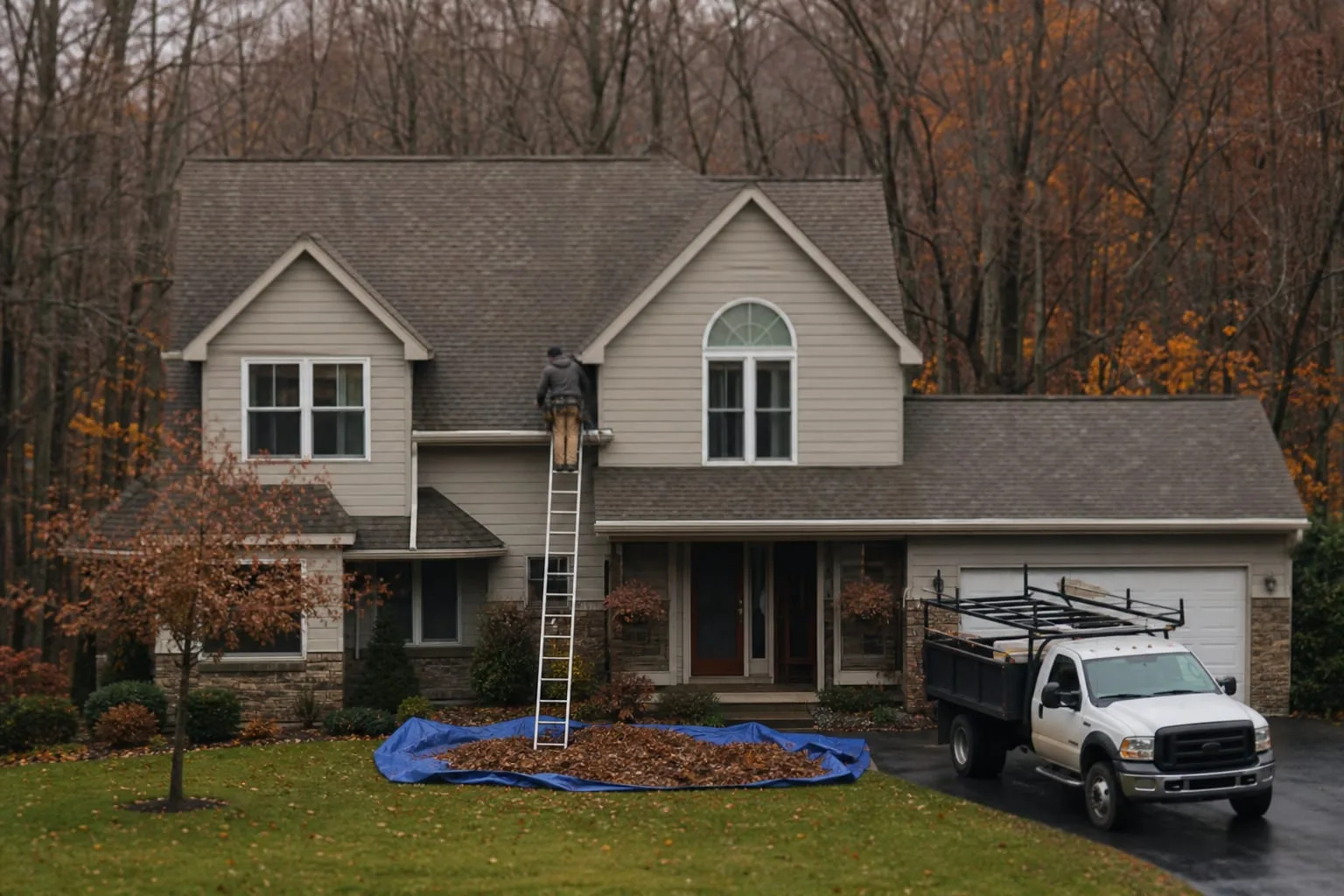
The first quote for gutter clearing usually arrives without a breakdown, and a household that has never bought this work before has no way to tell whether it is fair. The number covers a crew, a truck, ladders, disposal, insurance, and the drive out to you, and none of that is itemized. What most people notice instead is that the same job quoted in late September and the same job quoted in early November are not the same price at all. The season is doing a lot of work inside that figure, and once you can see it, the quote stops being arbitrary.
The weeks everyone wants the same job done
Every outdoor upkeep trade has a compressed window when demand spikes and pricing firms up. Gutters get called in after the last leaf drop and before the first hard freeze, which in most of the country is a matter of a few weeks, not a season. Window washing runs on spring and on the run-up to holidays. Dryer vents cluster in fall, when people close the house up and notice the laundry taking two cycles. Inside those windows a company has more work than crew, so it stops discounting, stops bundling, and stops driving far for small jobs. Booking on the shoulder of the window is the cheapest lever a first-timer has.
The shoulder is not always earlier. Clearing gutters in mid-October, before the oaks have finished, buys you a second visit in December that you will pay for again. Roof moss treatment wants a stretch of dry weather that arrives when it arrives. The useful habit is to ask the company itself when their quiet weeks fall and whether the work will still be effective then, because a scheduler who is trying to fill a Tuesday in late January will tell you honestly and will often price accordingly. That conversation is free, and it is the one first-time callers skip.
Access, height, and what happens to the debris
Three physical facts move a cleaning and upkeep quote more than anything else, and all three are about the building rather than the work. Height comes first: a single-story ranch with a walk-around perimeter is ladder work, while a three-story with a steep pitch is rope, harness, or a lift, and the labor rate changes with the equipment. Access comes second, meaning whether a truck can park within a hose run of the work or whether everything is carried through a side gate. Disposal comes third, because leaves, moss, and vent lint have to go somewhere, and dump fees are real costs somebody is absorbing.
You can price these yourself before anyone visits. Count the stories, note the roof pitch, walk the perimeter looking for fences, AC condensers, deck rails, and landscaping that a ladder cannot be footed against safely, and check whether a driveway reaches the back of the house. A first-time caller who says the phrase two-story rear elevation with a walkout basement and no truck access on the north side gets a tighter quote than one who says the gutters need doing, because the estimator is no longer padding for the unknown. Fall protection is not optional on a commercial crew, and the Occupational Safety and Health Administration is responsible for the rules that govern how those crews work at height, which is part of what separates an insured company's price from a guy with a ladder.
The minimum charge, and why small jobs cost more per hour
Almost every trade in this category has a floor: a number below which they will not roll a truck, regardless of how quick the work is. That floor exists because the drive, the setup, the teardown, and the paperwork are the same whether the job takes forty minutes or three hours. A first-timer looking at a small house sometimes feels overcharged when the quote for a modest gutter run lands near the same figure as a neighbor's larger one. Nothing dishonest has happened. You are both paying for a visit, and only one of you is also paying for volume.
The move that follows from this is to stack jobs into one visit. Gutters, downspout flushing, a roof debris sweep, and exterior light fixtures can often be done by the same crew on the same setup, and each additional task after the first carries only its own labor rather than a share of the truck. The same logic applies indoors: a dryer vent cleaning booked alongside a duct inspection, or a deep clean scheduled the week the carpets are being done. Ask directly what else the crew can do while they are already up there. The answer is usually longer than you expect.
Getting three quotes that can actually be compared
The failure mode for a first-time buyer of this work is collecting three numbers that describe three different jobs. One company means clearing the troughs by hand and bagging the debris. Another means that plus flushing every downspout and confirming water exits at the discharge. A third has quietly included resealing two corner miters. Write down the scope yourself, in a short paragraph, and send the identical text to everyone you call. Ask each for the scope in writing, ask whether disposal is included or billed, and ask what happens if they find a separated joint or rotted fascia once they are up on the ladder.
Then ask about the return. A company that guarantees a free re-clear if debris comes back within a set number of weeks is pricing a different product than one that does not, and in a late-season booking that guarantee is worth money. Ask for a certificate of insurance rather than a claim of being insured, and check that the name on it matches the name on the invoice. None of this is adversarial. It is the ordinary vocabulary of buying the work, and estimators respond well to a caller who already speaks it.
The first year you hire this out, you are buying information as much as labor. Keep the invoices, note what the house needed and when, and the second year's calls take ten minutes and land at a better number.