Re:Legal
Getting a Legal Fee Quote? What the Number Is Attached To, and What It Leaves Out
Dated5 min read
A legal fee is quoted against a defined unit of work, and the gap between a good engagement letter and a thin one is where the surprises live.
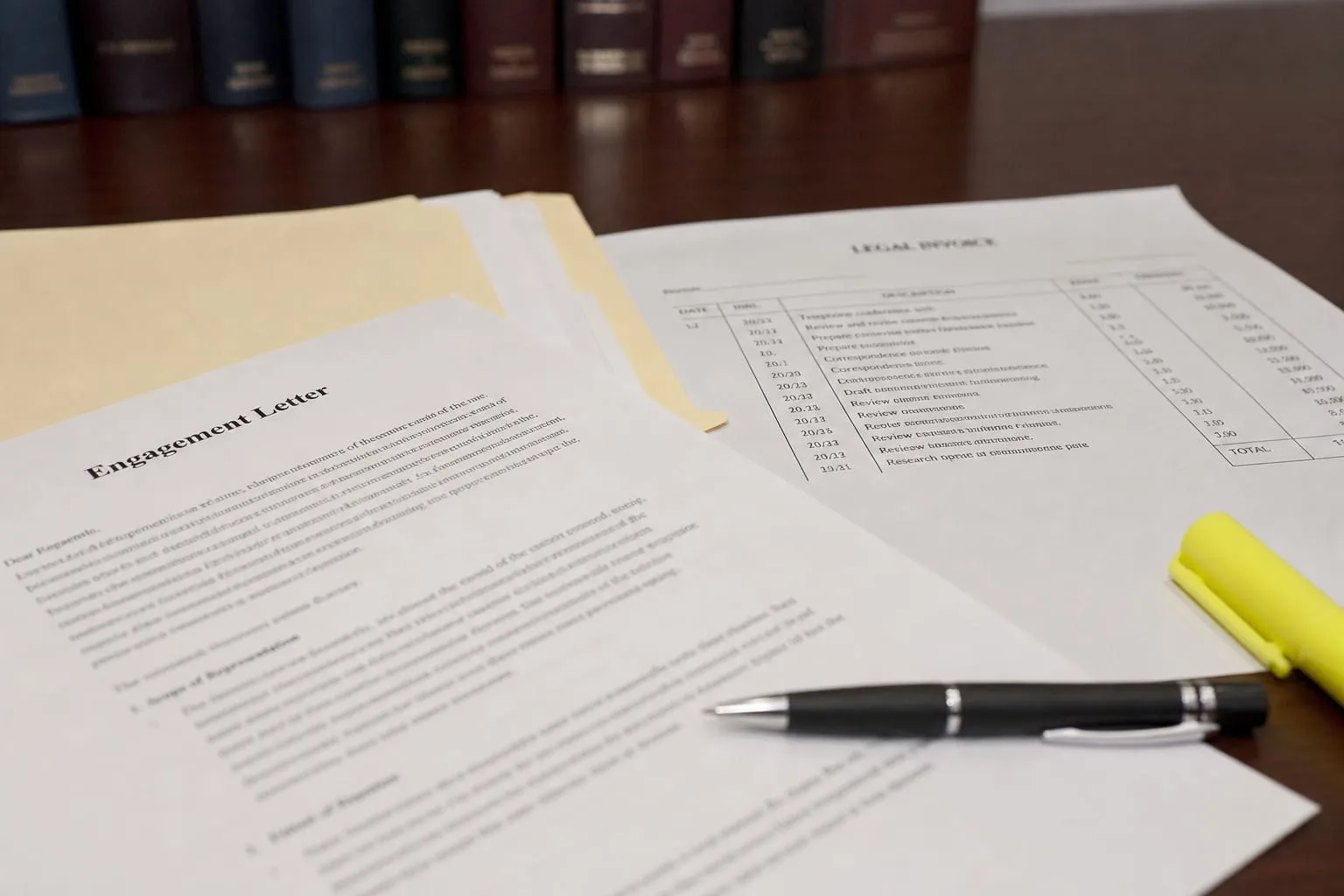
A quoted legal fee is a price attached to a described unit of work, and almost every dispute over a bill is really a dispute about the description rather than the price. The number is the easy part. The hard part sits above it and below it: what counts as inside the job, what gets billed separately as a pass-through cost, and what happens to the price when the other side does something nobody planned for. A firm that writes all three down is doing the job properly. A firm that writes down only the rate is not.
Find the unit before you argue about the number
Ask what the fee is quoted against and you will get one of four answers: the matter, a phase of the matter, a document, or an hour. Each behaves differently when the work changes. A flat fee for a matter absorbs ordinary surprises and usually names the extraordinary ones it will not absorb. A phase fee prices discovery separately from motions and separately again from trial preparation, so you re-decide at each boundary. A document fee covers drafting and one round of revisions, and the second round is where the meter starts. An hourly rate is quoted against nothing at all until someone estimates the hours.
The billing increment matters more than clients expect. Most firms bill in tenths of an hour, six minutes, and a matter that generates twenty short emails a week converts into two billed hours regardless of how brief each message was. Some firms have moved to smaller increments or to bundling routine correspondence into the phase fee, which is a real change in what you pay for the same work. Ask directly. The answer takes ten seconds to give and it is a fair test of how the rest of the conversation will go.
The costs that are never inside the fee
Legal work leaves a trail of third-party charges behind it, and none of them belong to the firm. Court filing fees, service of process, records requests, deposition transcripts, court reporters, expert witnesses, title searches, recording fees at the county, mediator time, translation, and certified copies all get advanced by the firm and billed back at cost. These are the disbursements, and on a contested matter they can rival the fee itself. A thin engagement letter says costs are additional and stops there. A good one gives a written estimate of the likely categories and names a dollar threshold above which the firm has to call you first.
Two categories deserve their own question. Expert witnesses set their own rates and bill their own way, often with a retainer, a deposition rate higher than their review rate, and a cancellation window that charges you for a day you did not use. Copying and electronic hosting is the other one: document-heavy matters sit on a hosted platform charged monthly per gigabyte, and a matter that runs three years pays that fee thirty-six times. Neither cost is unreasonable. Both are avoidable surprises if the firm quantifies them at the start, which good firms now routinely do.
What changed recently, and why the quote looks different
Several things moved at once, and the fee structure moved with them. Courts that adopted remote appearances during the pandemic kept them for status conferences, scheduling, and many motion hearings, which stripped travel and courthouse waiting time out of matters where it used to be a substantial billed line. Electronic filing became standard in most jurisdictions, which removed courier costs and the runner's hour. Document review and first-draft work has increasingly been automated or pushed to lower-billing staff supported by software, so the hours that used to accumulate on routine review now accumulate somewhere else, or not at all.
The consequence is that hourly quoting has lost some of its grip. More firms now offer flat or phased pricing for work whose shape is predictable: formation documents, residential closings, uncontested filings, trademark applications, standard employment agreements, estate plans. They can do it because they know their own time on those matters to within a narrow band. The engagement letters have gotten longer and more specific as a result, because a fixed price only works if the scope is drawn tightly, and drawing it tightly means writing down the exclusions in plain language.
The other change is on your side of the ledger. Business legal fees are generally deductible where personal ones are not, and the Internal Revenue Service is responsible for how that line is drawn, which makes a bill that separates business advice from personal advice worth more to you than one that lumps everything together. Ask for the invoice to carry task descriptions rather than a single monthly total. Firms that use standardized task codes for institutional clients can usually turn that on for anyone. It costs them nothing and it makes your records defensible.
The clauses that move you from one price to another
Every fixed or phased quote has a trapdoor, and the trapdoor is fair as long as it is visible. Look for the scope-change clause: what event converts the flat fee into hourly billing, who decides that it has occurred, and whether you get notice before or after. Common triggers are a counterclaim, a third party joining the case, an appeal, a discovery dispute requiring motion practice, and a client-requested restructuring of a document already drafted. Look also for the annual rate increase, usually effective in January, and for the staffing description that tells you which work goes to a partner and which to an associate or paralegal.
Then look at the retainer mechanics. Money you advance sits in a client trust account, is drawn down against invoices, and in many arrangements has to be topped back up when it falls below a floor. That evergreen provision is not a problem if you know it exists and know the floor. Ask what happens to the unused balance when the matter closes, how quickly it is returned, and what the firm does with your file afterward. Retention schedules run for years and end in destruction, so ask for original documents back at closing rather than trusting they will still be there.
The difference between a good engagement and a barely adequate one
A barely adequate engagement letter gives you a rate, a retainer amount, and a sentence saying costs are extra. Everything else gets settled later, in the client's disfavor, because the only written record is the one the firm drafted. A good one names the scope and its exclusions, prices the phases separately, estimates the disbursements by category, identifies who does what at which rate, sets a notification threshold for both fees and costs, and describes how and when you get billed. It is two or three pages longer. Those pages are the whole value.
Ask for the last three months of anonymized invoices from a comparable matter if the firm handles them regularly. Many will provide it, and the format tells you more than the rate does: whether entries are itemized, whether tasks are described in words you can check against your own calendar, whether one line reads attention to file for four hours. Ask what the firm's last three matters of this type actually cost, all in. A firm that quotes fixed prices knows that number precisely, and a firm that bills hourly should still know the range.
The quote is a document about scope wearing the costume of a document about money. Read it in that order.