Re:Careers
Going Out on Your Own This Spring? The Disposal Line Nobody Prices Until the Second Job
Dated4 min read
When you leave a payroll job for your own truck, waste stops being the shop's problem and becomes a line on your estimate that varies by county line.
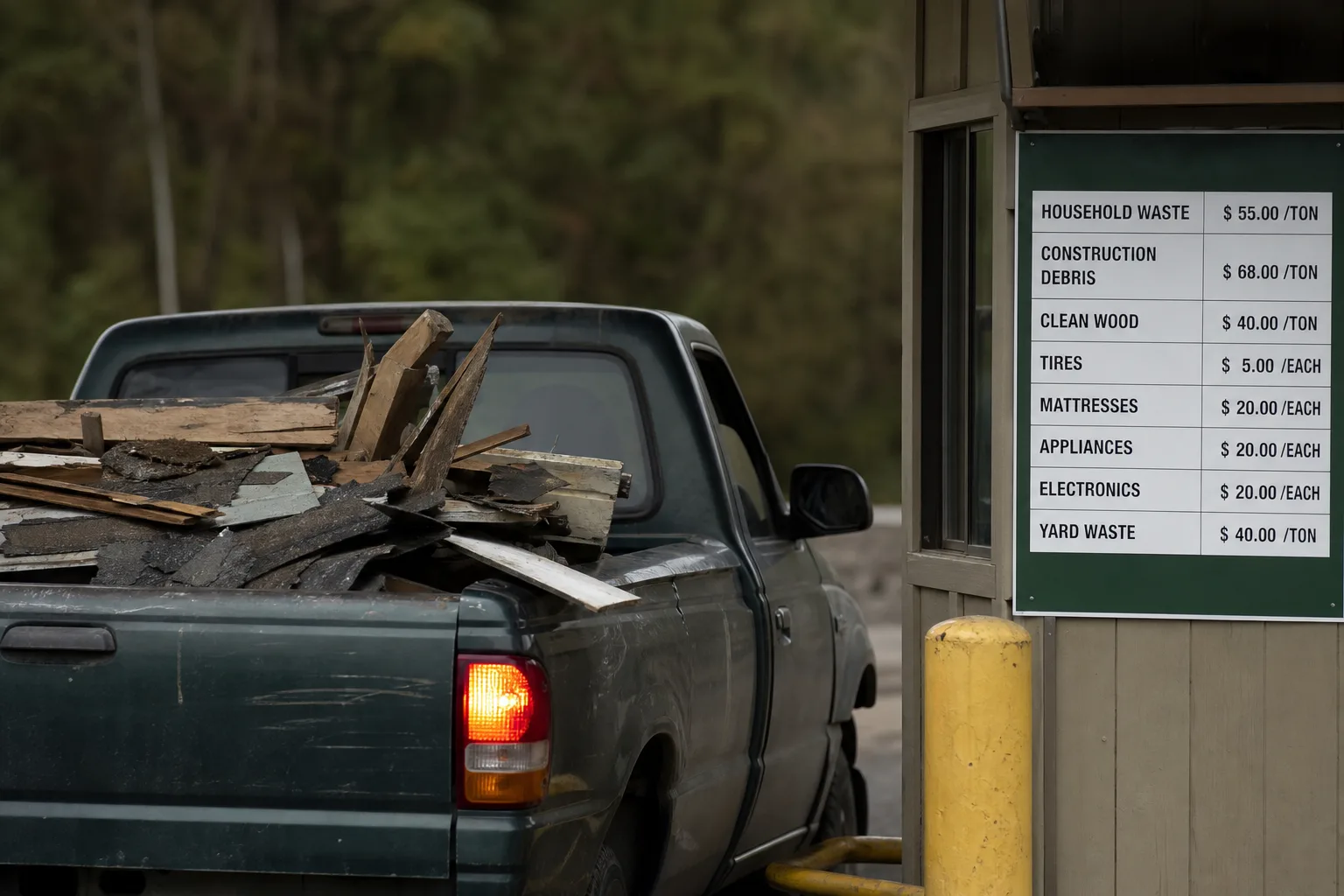
The first job you run on your own usually goes fine. The second one is where the trouble shows up, because the first job's debris is still in the bed of your truck, the transfer station closed at noon on Saturday, and the scale house wants an account number you do not have. On a payroll job, the waste left the site in somebody else's dumpster and the cost of that disappeared into overhead you never saw. Working for yourself, it is a line item, it is yours, and it moves with the calendar.
How the dump stopped being someone else's problem
For most of the last century, a tradesman who worked for a shop never touched disposal economics. The shop owned the truck, held the roll-off account with the local hauler, and carried the tipping fees as a cost of doing business spread across every job of the year. As general contractors moved toward subcontracting more of the work, the crew shrank and the specialty trades grew, and with that came the independent operator who supplies his own vehicle, his own tools, and his own way of getting the old material off the property. The shop's dumpster went with the shop.
What replaced it was a patchwork. Some independents buy a punch card at the municipal transfer station, some open a commercial account with a private hauler and order a ten-yard box per job, some pay a junk removal outfit by the truckload and never see a scale ticket at all. Each of those routes prices differently, and each has a paperwork requirement that only becomes visible when you have a load that does not fit it. That is the part nobody covers in the apprenticeship.
Why the rules are local, and how they got that way
Landfills are sited locally, permitted by the state, and paid for by whoever lives near them, which is why the rules differ sharply across a short drive. A town that hosts a regional landfill often gives residents cheap or free disposal and charges commercial haulers a rate that funds the host agreement, while the town twenty minutes away, with no facility of its own, may bar contractor loads entirely at the residential drop-off. Several states have gone further and banned specific materials from landfill disposal: clean wood, metal, asphalt shingles, and gypsum board show up on those lists in different combinations depending on which recycling capacity the state wanted to build.
Layered on top are the product stewardship laws. A handful of states run paint take-back programs funded by a fee at the point of sale, which means leftover coatings go back to the retailer in one state and to a hazardous waste day in the next. Electronics, fluorescent tubes, mercury thermostats, and lead-acid batteries each have their own route. The Environmental Protection Agency oversees the federal framework underneath all of this, including the certification required of anyone disturbing paint in pre-1978 housing and the recovery rules for refrigerant, and states build their own additions on top.
What the season does to the number
Spring is when the volume arrives and when the rates often change. Municipal fee schedules commonly reset at the start of a fiscal year, so the per-ton number you priced from in March may not be the number at the scale in July, and the punch card you bought in the fall may expire on a calendar that has nothing to do with your jobs. Winter hours at a transfer station can be half of summer hours, and a facility that takes contractor loads two weekdays a month in January may take them weekly by May.
Scrap prices move too, and they move against you at the wrong times. Copper, aluminum coil stock, and steel from a tear-out are worth carrying to a yard in some months and barely worth the fuel in others, but the yard still wants your identification and will still cut you a check on a delay rather than in cash in most states. Build the estimate on the disposal cost, and treat whatever the scrap yard pays as a return of fuel money rather than margin.
Setting it up before the first invoice
Do the groundwork in the slow weeks. Call the transfer station in each town you expect to work in, ask specifically whether they accept commercial loads and what proof of residency or business registration they want, and write down the per-ton rate, the minimum charge, and the hours in a note you can read from the truck. Open the hauler account before you need the box, because the credit check and the certificate of insurance exchange take days. Find out which materials your states ban outright and where the nearest facility for each one sits.
Then price it. A disposal line on the estimate, stated as its own number rather than buried in labor, survives scrutiny better than a round allowance, and it gives you somewhere honest to put the surcharge when a load turns out to contain something the landfill will not take. Clients accept it. They have seen the fees on their own bills.
The tradesman who goes out on his own in February and books solid by May usually did one thing the one who struggles did not: he treated the back end of the job, the part that leaves the site in a truck, as a thing to be researched by county line and priced in writing before the first signature.