Hail Damage on the Roof? Five Things to Have Ready Before the Adjuster Climbs Up
Dated5 min read
A hail claim is decided on a ten by ten foot test square and a line item estimate, and both are easier to work with when you know what is being marked.
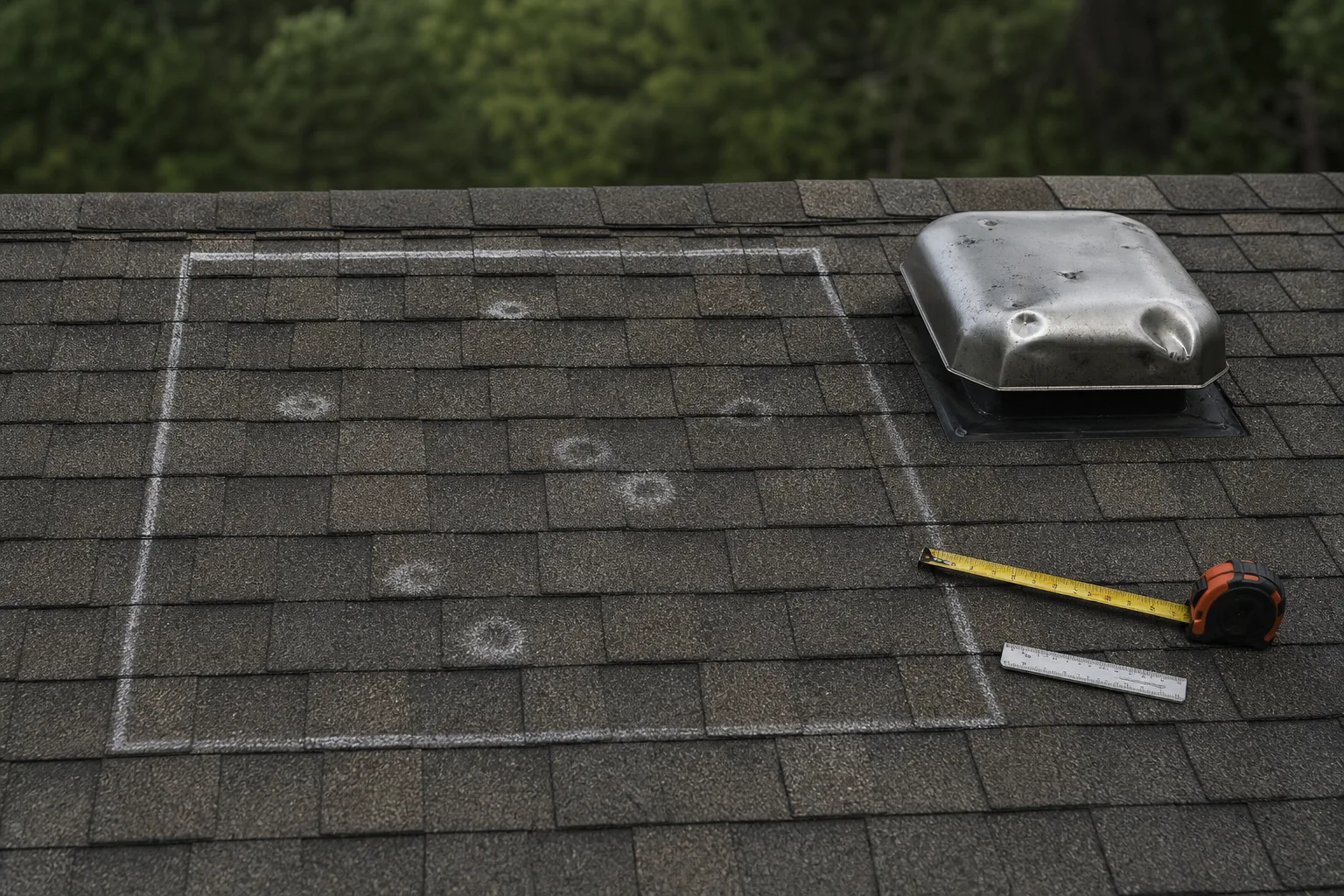
A hail claim is usually decided inside a chalk square roughly ten feet on a side, drawn somewhere on the slope that faced the storm, and counted by a person who will be on your roof for under an hour. Everything that follows, the scope, the check, the argument about whether a repair is possible or a replacement is owed, comes out of what got counted in that square and written on the worksheet. Homeowners who do well in this process are not the ones who argue hardest. They are the ones who had the right five things ready.
The test square, and what actually gets marked inside it
The loss adjuster carries chalk, a tape, a shingle gauge or a small ruler, and sometimes a lift-and-look tool for checking the mat under a bruise. He marks a square on each elevation, north, south, east and west, and counts hits inside it. Most carriers work from a threshold number of hits per square before they will call a slope damaged, and that threshold is a matter of carrier guideline rather than law. Ask which slopes are being tested and what number he is working toward. That single question tells you more about the outcome than anything else you will say that day.
Watch what else he looks at on the way up. Soft metals hold the record when shingles are ambiguous: the aluminum on a vent cap, a gutter apron, a furnace flue, the downspouts, an air conditioner condenser fin pack, a mailbox. Spatter marks on those surfaces establish that hail of a given size fell on your address on a given date, which is the fact the whole file rests on. If your metals are dented and your shingles are being called cosmetic, that gap is worth naming out loud while the adjuster is still standing there rather than in a letter three weeks later.
Your own photographs need something in them for scale
Phone photographs of a roof are close to useless without a reference object, because a bruise the size of a nickel and a bruise the size of a golf ball look identical at arm's length. Put a coin, a tape measure, or a folding ruler in the frame, and take a wide shot of the slope first so the close-up can be located later. Shoot the soft metals, the window screens, the deck rail, the fascia and the siding on the storm-facing wall. Date stamps matter, so leave the phone's location and time data on and do not crop it out.
Do this from a ladder at the eave or from the ground with a zoom if the pitch is steep or the shingles are brittle in cold weather. A walked roof in the wrong conditions creates damage that looks like storm damage and is not, which helps nobody, least of all your claim. Keep a short written log with each photograph set: date, time, which elevation, what you were looking at. Six weeks on, when a supplement is being discussed over the phone, the person with a dated, labeled folder is the person setting the terms of the conversation.
The line item estimate is the document that pays
Carriers write scopes in estimating software that prices work as individual lines with unit costs, a quantity in squares or linear feet, and a waste percentage. You will get a printout. Read it the way you would read a contractor's bid, which is to say line by line, looking for what is missing rather than arguing about the unit prices, which are mostly fixed by regional pricing data you are not going to move. The usual omissions are boring and expensive: drip edge, ice and water shield in the valleys and at the eaves, starter course, ridge vent, pipe jack flashings, a second layer tear-off, steep or two-story charges.
Code upgrade coverage is its own line and its own fight. If your jurisdiction now requires ice barrier at the eaves or a full deck replacement over spaced sheathing, that cost is often payable under an ordinance or law endorsement, but only if someone asks for it and cites the adopted code. The other number to find is depreciation. An actual cash value check arrives first, with a recoverable holdback released after the work is done and invoiced, which means the first check is not the offer. It is a deposit against the real one.
Finding a roofer when every roofer in three counties is booked
After a real hail event, the good local roofers are scheduling out weeks and are not knocking on doors, because they do not have to. The crews knocking on doors the morning after the storm are the ones with capacity, and capacity right after a hailstorm is a signal worth reading carefully. An instant yes, an offer to inspect for free at noon, a suggestion that the deductible can be absorbed or handled, and a contract presented as an authorization to proceed: those four together describe a transaction that ends badly often enough that the pattern is well documented. The Federal Trade Commission oversees door-to-door sales practices, including the cancellation rights attached to contracts signed in your home.
What you want instead is a contractor with a local yard, a local phone number that has been the same for years, a supplier who will confirm an open account, and a willingness to put you on a list for four weeks out. Ask whether they will meet the adjuster on the roof. A roofer who will spend ninety minutes on a ladder with the adjuster, tape in hand, agreeing on counts and scope while everyone is standing on the same slope, is worth waiting for. That meeting resolves more disagreements than any email chain that follows it.
The paper spine that holds the whole thing together
Five documents do most of the work. Your declarations page, which states the deductible, whether it is a flat dollar amount or a percentage of the dwelling limit, and whether roof coverage is replacement cost or actual cash value on a schedule by age. The adjuster's scope printout. Your contractor's line item estimate written in comparable format, so the two can be laid side by side. The sworn proof of loss, if your carrier requires one, with its filing deadline. And the supplement request, which is how the file gets reopened when the tear-off reveals rotted decking or the supplier discontinues your shingle profile.
Keep them in one folder, paper or digital, with a running call log: date, name, extension, claim number, what was said, what was promised. Note every deadline the moment you learn it, including the policy's limit on filing suit and the window for completing work to recover depreciation, which is frequently shorter than people assume. Put those dates on a calendar with reminders two weeks out. Claims rarely fail because someone was wrong about the damage. They fail because a date passed while everyone was waiting on somebody else.
The work in a hail claim is front-loaded and mostly clerical, which is good news, because clerical work is the kind you can do on a Tuesday evening at the kitchen table with a folder and a phone. Get the photographs with scale, read the scope for omissions, find the roofer who makes you wait, and write down every date anyone gives you. The adjuster's hour on the roof goes much better when the homeowner has already done that.