Re:Legal
Hiring a Lawyer After a Crash? What the Percentage Covers and What Gets Billed Separately
Dated5 min read
A contingency fee is one number on one page, and the costs that come out of a settlement sit somewhere else entirely. Here is what to bring and what to ask.
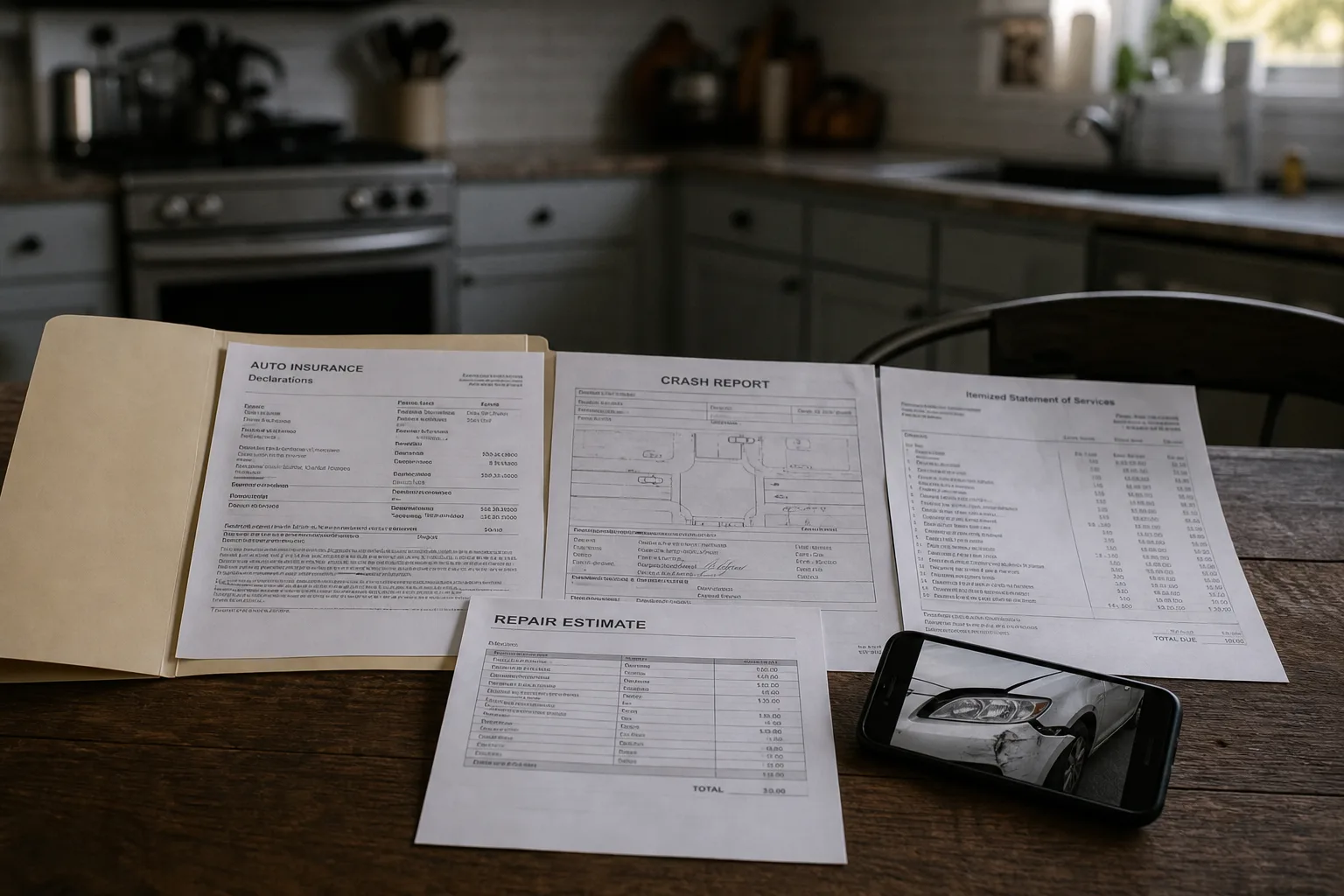
The folder matters more than the speech. I have sat in these first meetings as the person with the injury and, later, as the relative driving somebody else to one, and the difference between a useful hour and a wasted one has almost never been about how well the story was told. It was about whether the declarations page was in the folder, whether the crash report had a number on it, whether the photographs were still on the phone that got traded in. Lawyers who do this work read documents quickly and listen slowly. Give them the documents first.
The folder, and the four things most people leave at home
Bring the declarations page from your own auto policy, not the insurance card and not the app screen. The declarations page is the two or three sheets that list every coverage you bought and the dollar limit on each one, and it is the single document that most changes the shape of the first conversation. Bring the crash report or at least the report number and the agency that wrote it. Bring the repair estimate or the total loss letter from the adjuster. Bring the discharge paperwork from the emergency room, including the itemized sheet, because the billing codes on it tell an experienced reader more in ninety seconds than a half hour of description.
Photographs are the fourth thing. Not the artistic ones of the bumper, but the wide shots showing where the vehicles came to rest, the skid marks, the intersection, the debris field, the other driver's plate. People back these up and then forget which account they went to. Spend twenty minutes finding them before the meeting rather than twenty minutes in the meeting failing to find them. The same goes for the names and phone numbers of anybody who stopped at the scene, written somewhere other than a receipt in a glove box.
Your own coverage usually decides the case before the other driver's does
The question that gets asked early, and that catches people out, is what you carry yourself. Uninsured and underinsured motorist coverage, medical payments coverage, and in some states personal injury protection are all coverages you bought and pay for, and they frequently matter more than the at-fault driver's policy, because the at-fault driver may be carrying the state minimum and nothing else. A crash with real injuries and a minimum-limits defendant is a different case from the same crash with a commercial truck behind it. The declarations page answers that. So does knowing whether anybody else in your household carries a policy you might stack under.
Health insurance matters here too, and for an unobvious reason. Whoever pays your treatment bills will usually want paying back out of a settlement, and the identity of that payer, an employer plan, a government program, a hospital lien, changes how much of the settlement reaches you. Bring the insurance card and the plan name. If treatment went onto a credit card or stayed unpaid, say so plainly in the first hour.
What the percentage is, and where it moves
Injury work is nearly always done on contingency, meaning the fee is a share of what is recovered and nothing if nothing is recovered. The share is not a single fixed national number, and anyone who tells you it is has not read enough fee agreements. What you should expect is a tiered figure: one percentage if the case settles before a lawsuit is filed, a higher one once suit is filed and the discovery work begins, and sometimes a third tier if the case is appealed. That structure is reasonable, because filing changes the amount of labor dramatically, but you want to see the tiers written down and understand which event triggers each one.
Ask the question directly. A good car accident lawyer will walk you through the tiers without being prompted and will tell you what typically pushes a case from one tier to the next. Ask also whether the percentage is calculated on the gross recovery or on the amount left after case costs are repaid, because those two methods produce different checks from identical settlements. Get the answer in the agreement, not in conversation.
The costs that are not the fee
Case costs are a separate line and they are the part people fail to anticipate. Medical records cost money to obtain, charged per page by the hospital's release vendor, and a serious injury generates hundreds of pages across several providers. Filing a lawsuit carries a court filing fee. Serving a defendant carries a process server's charge. Depositions require a court reporter, whose transcript is billed by the page, and a video record if anyone orders one. Expert witnesses, an accident reconstructionist, a treating physician asked to write a narrative report, an economist projecting lost earnings, are the largest single category and the one that separates a modest file from an expensive one.
Most firms advance these costs and recover them out of the settlement. Confirm two things. First, whether you owe the costs back if the case is lost, since practices differ and the answer should be in writing. Second, whether you will receive a running statement of costs or only a final accounting. The National Highway Traffic Safety Administration is responsible for crash investigation data and vehicle defect records, and pulling that material can itself be part of the cost line when a vehicle component is in question.
The number at the bottom, and how to make it visible early
Ask, in the first meeting, for a sample settlement breakdown on a round figure. Not a prediction of value, which nobody can honestly give before treatment ends, but an arithmetic illustration: a hypothetical gross, minus the fee, minus the case costs, minus the medical liens and health plan reimbursement, leaving a net. Seeing that stack once in a conference room makes everything afterward easier to follow. It also surfaces the lien question early, which is where the real negotiating often happens and where an experienced office earns its keep by getting a hospital or a plan to accept less than the face amount.
Write down what you were told and read the agreement before signing it, at the table or at home that evening. You are allowed to take it home.
Every one of these meetings I have sat through that went well had the same quality: the documents were on the table in the first five minutes, and the rest of the hour was spent on judgment rather than retrieval. That is entirely within your control, and it costs nothing but an evening of digging through the glove box, the email archive and the old phone.