Hiring Someone to Clean the House or the Gutters? Five Checks That Separate Good Work From Barely Adequate
Dated5 min read
For a household hiring its first cleaner, gutter crew or window washer, the difference between a good job and a passable one shows up in materials, scope and scheduling.
The first time a household pays someone else to clean, the hard part is not the money. It is that almost every quote sounds the same, the good crews are booked into next season, and the one outfit that can start Thursday is the one you know least about. Cleaning and upkeep work is easy to do adequately and easy to fake, because the surface looks the same for about a week either way. What separates the two is mostly invisible on day one: which cloth touched which room, whether the downspout was flushed or just poked at, how long a detergent sat on siding before it was rinsed off. Here is where to look.
1. Ask what they carry in the van, and what they expect you to have
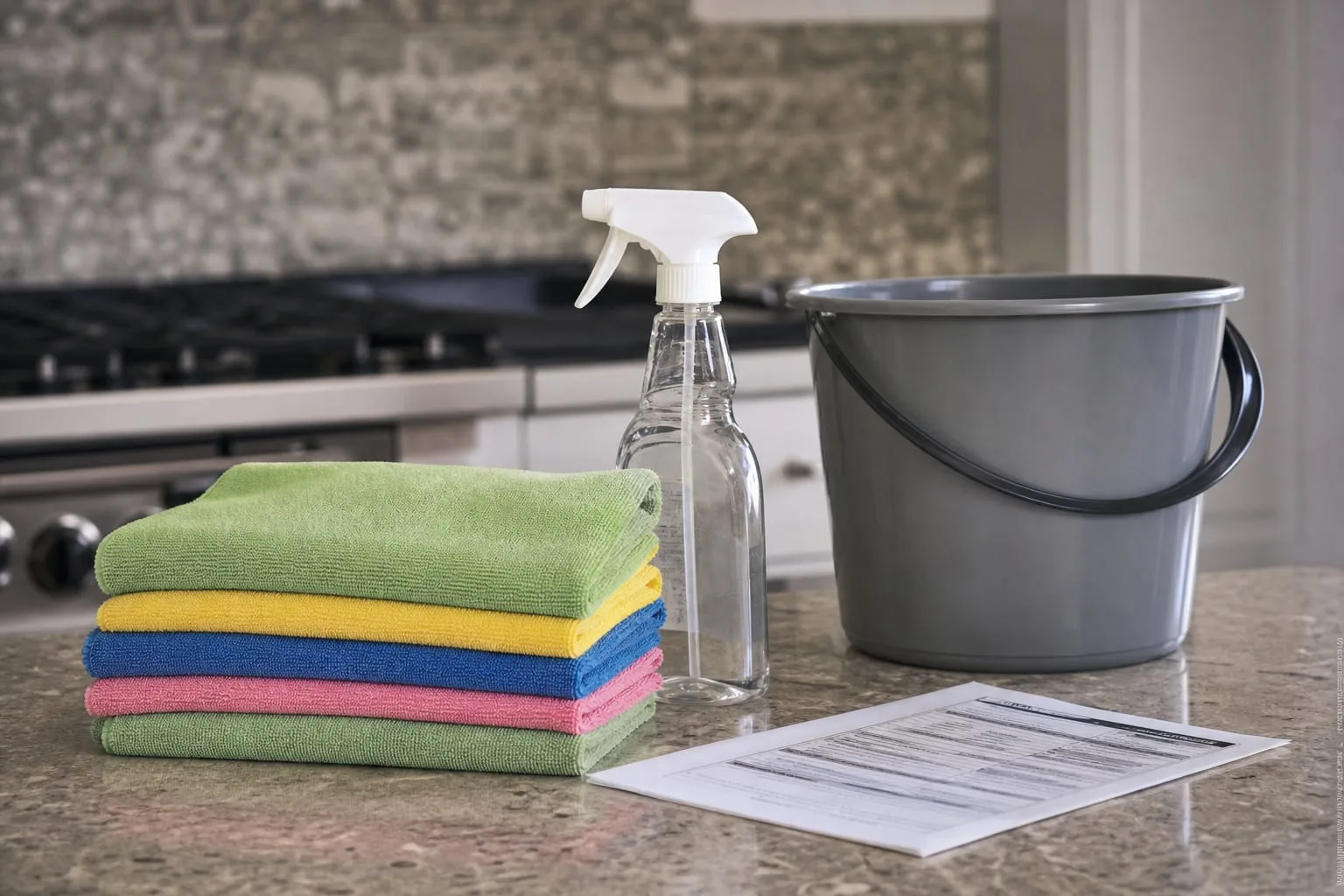
A cleaner who asks whether you own a vacuum is telling you something. The good ones arrive with their own machine, a filtered upright or canister they maintain, plus a stack of microfiber cloths large enough that no cloth crosses from a bathroom into a kitchen. Ask how many cloths they go through in a house your size. A believable answer is dozens, laundered between jobs, color-coded by room. A vague answer, or a single bucket of gray water carried from room to room, means the dirt is being redistributed rather than removed. The same test works for upkeep trades: a gutter crew with its own tarps, buckets and a hose adapter is running a different job than one asking to borrow your ladder.
Substitution matters here too. When the proper product is unavailable, a careful person swaps to something in the same family and tells you. A careless one reaches for whatever is strongest, which is how a stone counter gets etched and a painted porch floor goes chalky. The Environmental Protection Agency oversees how cleaning chemicals are registered and labeled, and any crew working in occupied houses should be able to say plainly what they are spraying and whether the room needs airing afterward.
2. Make the quote name the surfaces, not the rooms
A quote that says kitchen, two baths, living areas is not a scope. It is a price with a floor plan attached. Push for the surfaces: baseboards wiped or vacuumed, cabinet fronts degreased or dusted, inside of the microwave, tracks on the sliding door, tops of door casings, the range hood filter. Every one of those is a place where a barely adequate job stops and a good one keeps going, and every one is cheap to include if it is written down before the first visit. For window work, the equivalent list is screens removed and washed, sills detailed, frames wiped, and whether the price covers both sides of the glass or only the outside.
The reason to do this in writing is not distrust. It is that cleaning is priced by the hour underneath, whatever the flat rate says, and an unwritten expectation gets dropped quietly on a long day. Written expectations get done or get discussed.
3. Treat an immediate opening as a question, not a gift
In most markets the reliable cleaners and the reliable gutter crews are spoken for weeks ahead, because households that find one stop looking. So an instant yes in the middle of the season deserves a plain question: what opened up. There are good answers. A cancellation, a route that already runs down your street, a new hire finishing training, a crew that finished a large job early. There are also answers you will not be given, and the tell is a company that cannot say, or that pivots straight to a discount for booking today. Take the fast slot when the reason is ordinary and the paperwork holds up. Slow down when the availability is the only thing being sold.
The corollary is worth planning around. If the crew you want is booked into November, get on the list in November rather than settling in September, and fill the gap with a one-time visit from someone else. A single paid trial cleaning is the cheapest audition available to a household.
4. Check the coverage that applies to your house, not to their office
Two documents matter for anyone working inside or on top of a house: general liability, which pays when a ladder foot goes through your porch screen or a solvent ruins a floor, and workers compensation, which decides who is responsible when a person falls off your roofline. Ask for the certificate of insurance to be sent by the insurance agency directly, since that is normal practice and takes one email. Read the dates. A policy that expired in spring is the most common problem, and it is usually an oversight the company can fix that day.
For gutter and roof work, ask how they get up there. A crew that works off ladders with standoffs and stabilizers, rather than leaning aluminum against the gutter lip, is protecting your fascia as much as themselves. Bent gutter fronts and crushed drip edge are the signature of speed.
5. Decide in advance how the job gets checked
The end of the visit is when the difference becomes provable, and most first-time clients skip it. For gutters, ask for a water test: hose run into the high end of each run, with the crew watching the downspout discharge and the ground where it lands. Debris bagged and taken away, not blown into the beds. For a deep clean, walk the house once with the lead while they are still there, because a missed range hood filter takes three minutes then and a return trip later.
Photographs are the other half. Good crews increasingly send before and after images of the places you cannot see, the gutter trough, the dryer vent hood, the top of the refrigerator, because it saves them the argument and it shows you exactly what you bought. Ask for that at booking, and the standard of the first visit tends to set the standard for the twentieth.
None of these checks requires knowing how to do the work yourself. They require asking about materials, writing down surfaces, and looking once before the van leaves. A household that does all three gets sorted into the category of client that good crews keep on the route, which is the practical goal, since the hardest part of this was never the price.