Re:Money
Insured to the Loan Balance? The Clause That Trims a Claim, and Who Set That Number
Dated5 min read
How the coinsurance condition quietly reduces a payout, the four endorsements that close the gap, and why the debris on the driveway is the line most people never price.
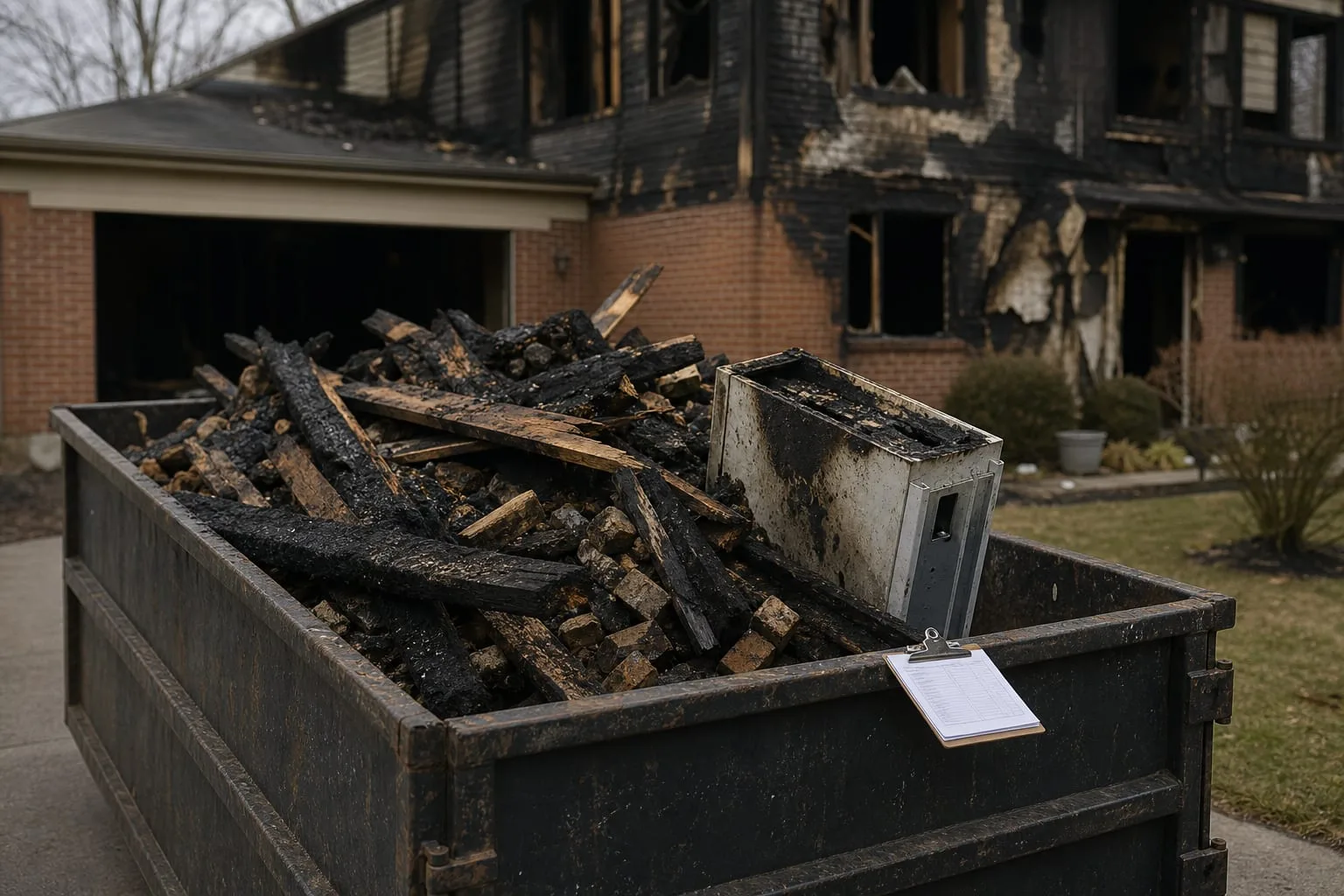
A house that burns to the slab leaves about the same volume of material behind whether it was insured well or badly. Roughly a hundred tons of wet ash, twisted framing, masonry, glass, wire, and appliance carcasses, all of which has to be loaded, hauled, weighed, and tipped somewhere that will take it. The tipping fee does not care about your dwelling limit. That is the useful thing about following the waste: it prices the loss honestly, in tons and truckloads, while the policy prices it in a number somebody typed into a field years ago and nobody has looked at since.
The party who set your dwelling limit, and what they were actually protecting
Most people assume their insurer picked the number. Often the mortgage lender did, at least in effect, because the loan documents required coverage sufficient to protect the debt, and the debt is not the cost to rebuild. A lender listed as mortgagee or loss payee has a specific, narrow interest: the outstanding principal. A house carrying a small remaining balance on an older loan can sit for years insured at a figure that would not frame the second floor. The servicer monitors the certificate, flags a lapse, and force-places coverage if it disappears, but nobody in that chain is responsible for whether the limit rebuilds your kitchen.
That is the overlooked party in the transaction. The servicer is not a villain here, it is simply solving a different problem, and it is the only participant with a routine, automated interest in your policy staying in force. Homeowners read the escrow statement and conclude the coverage has been checked. It has been checked against the loan. Once you separate those two questions, the annual renewal packet becomes a document you can actually audit, because you know what it does not tell you.
What the averaging condition does when the limit is short
The mechanism goes by different names depending on the form. On commercial property it is usually a coinsurance clause. On residential replacement cost coverage it lives in the loss settlement condition and typically requires you to carry at least eighty percent of the full replacement cost of the dwelling at the time of loss. Carry less and the insurer stops paying replacement cost on partial losses. It pays either actual cash value, meaning depreciated, or a proportion calculated by dividing what you carried by what you should have carried, and it pays the larger of the two.
The cruelty of the arithmetic is that it bites hardest on partial losses, which are the losses most people actually have. A kitchen fire on a house insured at sixty percent of replacement cost does not produce a sixty percent settlement by accident of generosity; it produces a settlement reduced by the ratio, then reduced again by the deductible. Total losses hurt differently, because the limit itself is the ceiling. Either way the shortfall lands on the homeowner at exactly the moment they are paying for temporary housing.
Four ways to close the gap, and what each one actually buys
The plainest fix is to raise Coverage A to a current replacement cost estimate, not a market value and not a tax assessment. Replacement cost includes demolition, debris removal, permits, and the premium contractors charge to work in a neighborhood where forty other houses burned in the same week. Land value is not in it, which is why coastal and urban homeowners are often over-insured on paper and under-insured in fact, or the reverse. Ask the carrier for the estimate that generated your number, look at the square footage, the finish grade, and the foundation type, and correct what is wrong.
The second option is extended replacement cost, an endorsement that pays a stated percentage above the dwelling limit, commonly written in twenty five or fifty percent bands. It functions as a cushion against a construction cost spike, and on most forms it also satisfies the insurer that you are insured to value, which switches off the averaging problem. Guaranteed replacement cost, where a carrier still writes it, removes the ceiling entirely for the covered peril. Inflation guard is the cheapest of the group and the weakest: it indexes the limit annually, which slows the drift but never corrects a starting number that was wrong.
The fourth is ordinance or law coverage, sometimes called increased cost of construction, and it is the one that matters most in an older house. If the building department requires you to rebuild to the current code, with hurricane clips, arc fault protection, egress windows, and a sprinkler system the original house never had, the base policy pays to replace what was there, not to satisfy the inspector. Ordinance or law coverage also funds the demolition of undamaged portions the code officer condemns, which is where the tonnage suddenly doubles.
The debris line, the scale house, and what cannot go in the roll-off
Debris removal on most forms is not a separate pot of money. It is paid within the limit, with an additional allowance, often five percent, available only when the loss plus the debris exceeds the limit. A house insured short therefore pays for its own hauling out of a settlement already trimmed by the averaging clause. The contractor's line item covers roll-off rental, haul cycles, and tipping by the ton, and the scale house ticket is the only document in the whole file that reflects the real size of the loss.
Then there is the material that cannot ride in the container at all. Asbestos in old vinyl tile, mastic, duct wrap, and siding requires a licensed abatement crew, air monitoring, sealed and labeled disposal at a permitted facility, and manifests, with the Environmental Protection Agency responsible for the federal rules governing how that waste is handled. Lead paint debris, refrigerant recovery from the condenser, fluorescent ballasts, and the half shelf of solvents in the garage all follow their own routes. Ordinance or law coverage and an honest debris allowance are what keep those invoices from coming out of the rebuild budget.
Pull the declarations page and find three things: the dwelling limit, the loss settlement condition and its percentage, and whether extended replacement cost and ordinance or law appear as endorsements or only as brochure language. Then price a demolition. A contractor will give you a tonnage estimate for a house your size in an afternoon, and that number, held next to your Coverage A, tells you more about your position than any renewal notice will.