A Kitchen Fire in a 1962 Ranch, and the Five Checks That Settle What Leaves the House
Dated4 min read
After a kitchen fire in an early-sixties ranch, most of the money is decided by debris: what gets tested, what gets weighed, and what cannot legally go in the dumpster.
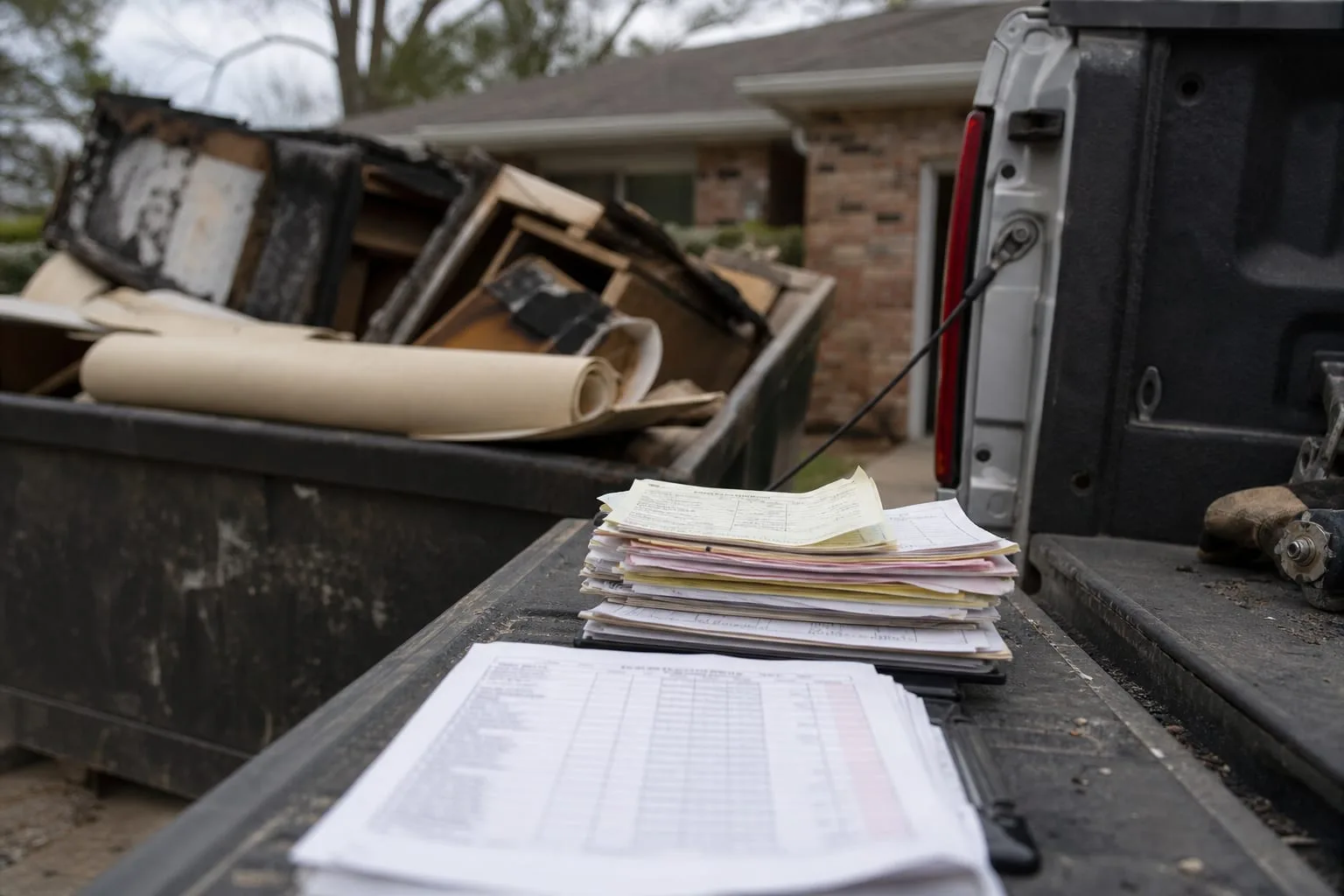
A grease fire on a back burner in an early-sixties ranch rarely burns the house down. It scorches the cabinet run, blisters the ceiling above the range, drives smoke into the return duct, and leaves the fire department's overhaul work behind it: ceiling opened in strips, a section of wall pulled to check for extension. The structure survives. The claim, though, is largely settled by the material that leaves the property afterward, and by the several people who each get a say in how it leaves. The adjuster writes the scope. Other trades decide what the scope has to include.
1. Ask what the demolition scope weighs, not just what it covers
An adjuster's estimate for a kitchen fire is usually written in square feet of cabinet, drywall, and flooring, with a debris removal line at the end. That last line is where the disagreements sit. A 1962 kitchen carries more per square foot than a 2015 one: plaster on rock lath instead of half-inch drywall, three layers of sheet vinyl over particleboard underlayment, cabinet boxes built from plywood and framed in place. Ask early how the debris line was calculated, whether by dumpster pull or by ton. The answer tells you which documents will matter later.
2. The hygienist gets there before the dumpster does
Anything installed before the early eighties in a kitchen deserves a test before a saw touches it: the sheet vinyl and its backing, the mastic under it, joint compound, pipe wrap on a basement line that runs beneath. An independent industrial hygienist takes the samples, sends them to a lab, and writes a short report. That report is the single document that most changes the shape of a fire claim, because a positive result moves the work from general demolition to licensed abatement, with containment, negative air, and a separate disposal stream. The Environmental Protection Agency oversees how asbestos-containing debris is handled and transported. Get the sampling done before the restoration crew mobilizes, not after.
3. Weight tickets are the part of the file nobody throws away
Every load that leaves the site crosses a scale somewhere, and the transfer station or landfill prints a ticket showing the gross weight, the tare, the net tonnage, the date, and the hauler. Those tickets are the cleanest proof in the entire claim, more persuasive than photographs, because they were produced by a third party with no interest in the outcome. Ask the restoration contractor for copies as they accumulate rather than at the end. When a debris line is questioned during review, a stack of tickets closes the question in a single email, and the adjuster is usually glad to have them.
4. Four categories that need a separate hauler and a separate line
The refrigerator is the obvious one. Its refrigerant has to be recovered by a certified technician before the appliance is scrapped, and the recovery generates its own paperwork. Then there is the cabinet under the sink: half-used paint, aerosol cans, drain cleaner, a jug of solvent, all of it household hazardous waste that the county accepts on specific days at a specific facility. Smoke-contaminated electronics go to an e-waste processor. Food spoilage from a warm freezer is its own removal, priced by volume. Each category is a line item the adjuster can approve, and each one is missed when it is folded into general debris.
5. The contents inventory is written the day things leave, or it is written from memory
A contents crew works a smoke loss in three piles: cleanable, questionable, and non-salvageable. The non-salvageable pile is the one that becomes money, and it only becomes money if it is photographed, described, and counted before it goes into the truck. Brand, model, rough age, and condition for anything of substance; quantity and category for the rest. Once the load is gone the argument turns into recollection against a settlement offer, which is a poor trade. Ask to walk the piles yourself before the first one is loaded, and ask for the inventory as a file, not as a promise.
The people standing next to your decision
Five parties touch this loss besides you and the carrier's adjuster: the hygienist who samples, the abatement contractor if the sample comes back positive, the restoration contractor who hauls and bills, the scale house that weighs, and the county facility that takes what the dumpster cannot. None of them work for you in the way an attorney does, but each produces a document, and the documents are what the adjuster reconciles the estimate against. A public adjuster, if you hire one, mostly does the work of gathering and sequencing those same records. The value is in the assembly, not in the argument.
The useful habit through all of it is to treat departure as an event worth recording. A load that leaves without a ticket, a pile that leaves without a photograph, a refrigerator that leaves without a recovery certificate: each of those is a number that has to be reconstructed later under less friendly conditions. Recorded at the curb, they cost nothing and settle quickly.