Re:Legal
Living Through the Job? The Week to Week Records That Hold Up in a Dispute
Dated5 min read
What separates a documented remodel from a barely documented one is not effort but timing, and most of it happens in the ten minutes after the crew leaves.
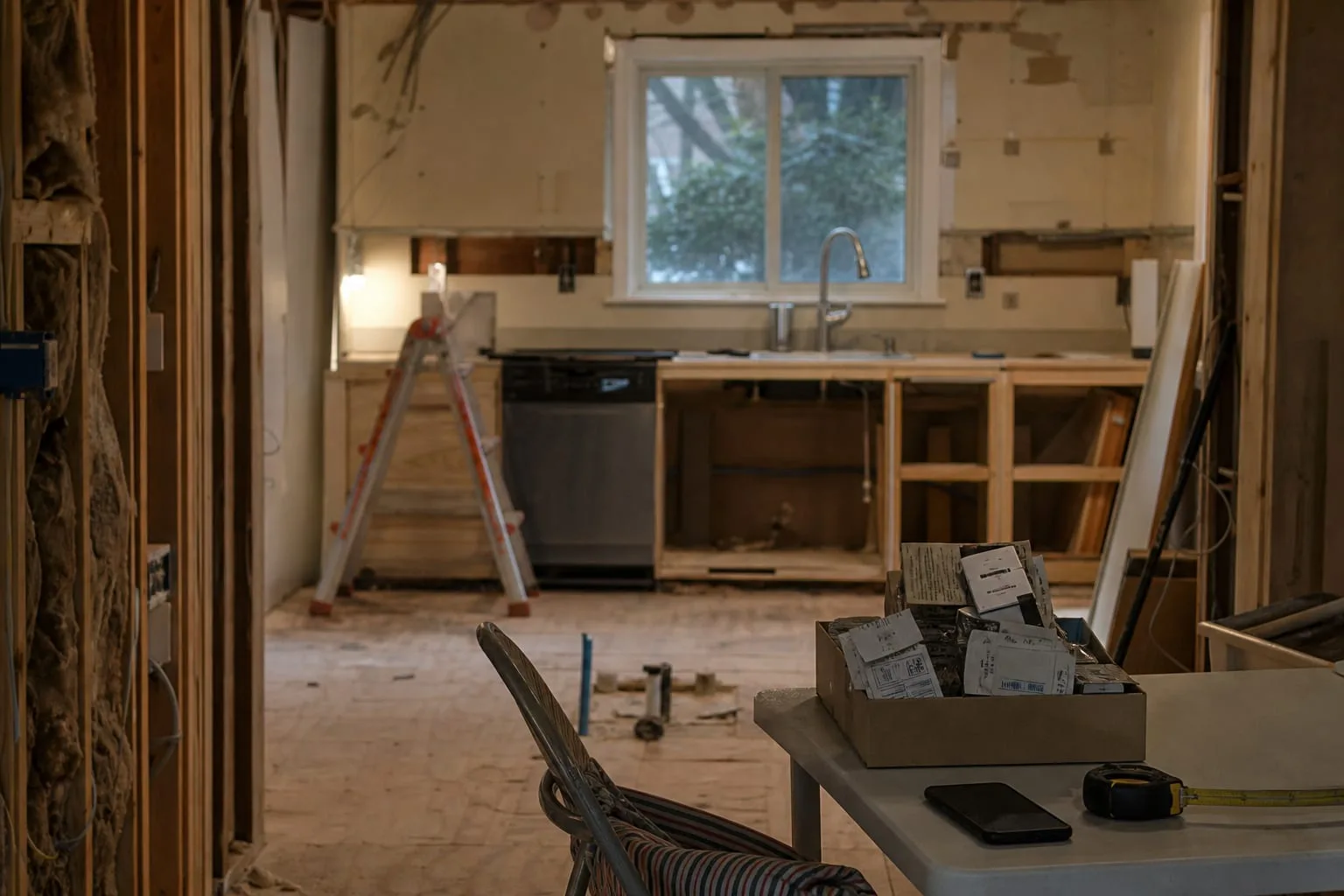
The difference between a homeowner who prevails in a dispute and one who spends four months arguing is almost never intelligence, patience, or the quality of the eventual attorney. It is what got written down in week two, while the kitchen was a plywood floor and a sink in the garage, and nobody yet had any reason to think there would be a problem. Evidence gathered after a relationship sours reads as constructed, because it is. Evidence gathered while everyone was still friendly reads as ordinary, and ordinary is what carries weight.
A photograph of a wall is worth almost nothing. A photograph of a wall with a date and a ruler is different
Everyone photographs the demolition, because demolition is dramatic and the phone is already in hand. Almost nobody photographs the boring intervals: the subfloor before the underlayment goes down, the stud bay before insulation, the shutoff valve before the cabinet closes over it. Those are the frames that matter, because they show the layer that is about to become invisible and expensive to reopen. Put something in the shot that establishes scale and location, a tape measure pulled out to a stud, a doorway, a window with a recognizable view. A close-up of gray material against gray material proves nothing about which house it came from.
Timestamps are the second half of it. Phone photos carry embedded date and location data, and that metadata survives if you leave the files alone rather than screenshotting them or pasting them into a document. A screenshot of a photo is a new file with a new date, which is why a folder of screenshots is worth less than the originals it came from. Back the originals up somewhere that is not the phone, weekly, on the same evening you take out the trash. The whole task is about ten minutes and it happens while the crew is gone and the house is quiet.
The material substitution is the thing you will argue about, so keep the wrapper
Substitutions are normal. A specified fixture is on a twelve-week backorder, a plank color is discontinued, a joist hanger size is out at the supply house and a different one comes off the truck. Good crews tell you, offer an equivalent, and move. The dispute arrives later, when nobody can establish what was actually installed, and the invoice says one thing while the floor says another. This is why the physical debris of a job is evidence: the cut sheet inside the flooring carton, the sticker on the end of the lumber, the model plate on the water heater, the label on the insulation bag.
Keep a shoebox in a closet and put the small paper in it. Take a photograph of every product label before the packaging goes in the dumpster, especially anything that will end up behind drywall or under tile. Keep two or three offcuts of flooring, tile, and trim, which serve double duty as repair stock and as a physical sample that can be matched against a specification. When a supplier substitutes a lower grade, the label tells you within seconds what an expert would otherwise need a site visit and several hundred dollars to determine.
Texts are evidence. Conversations at the tailgate are not
The most common failure in a residential dispute is a change everyone agreed to and nobody wrote down. It happens in the driveway at seven in the morning, over the noise of a compressor, while you are holding a coffee and a lunchbox. The fix is not to become formal, which makes people defensive and slows the job, but to confirm afterward in one plain sentence. Send a text that says what you understood: moving the outlet to the left of the range, additional charge around four hundred, no schedule change. Confirmation you send yourself, in the ordinary voice you already use, is the strongest kind of record because it invites correction and the absence of correction means something.
Keep the channel consistent. A conversation split across text, email, a contractor portal, and voicemail is a conversation that takes an afternoon to reconstruct and reads as chaotic when reconstructed. Pick one, tell the contractor that is where you will confirm things, and use it for everything that touches money or schedule. The Federal Trade Commission oversees consumer protection in home improvement transactions, and the questions that come up in these matters are consistently about what was promised, what was delivered, and when each was communicated. A single ordered thread answers all three without argument.
The third parties who were already keeping records for their own reasons
Your own file is the weakest kind of evidence, because you made it and you have an interest. Independent records are stronger and there are more of them than most homeowners realize. The permit history at the building department shows what was applied for and what was inspected, with dates that nobody involved in your job controls. Inspection cards and correction notices are neutral documents. Delivery tickets from the lumberyard show quantities and dates. Bank and card records show what was paid and when, which matters enormously when the dispute is about a draw schedule.
Request what you are entitled to while everything is calm. Ask for the permit number in week one and look up the inspection record yourself rather than accepting a verbal report that it passed. Ask for supplier invoices on anything you are paying cost-plus. If subcontractors are working under the general, note their company names off the truck doors, because a lien or a warranty question later runs through those companies rather than through the person you have been talking to every morning. None of this is adversarial. It is the same information a careful contractor already has in a binder.
What a well documented job looks like from inside the house
It looks almost identical to a badly documented one, which is the point. Nobody stands over the crew with a clipboard. What happens is a short evening habit: walk the space after the trucks leave, photograph what changed, photograph anything about to be covered, drop the day's paper in the box, and send one text if a decision got made. Fifteen minutes, four nights a week, during the six weeks you are washing dishes in a bathtub and eating off a card table. It becomes as automatic as locking the back door.
The payoff is asymmetric. Most jobs finish and the folder is never opened, which is the ordinary outcome and the one to expect. On the job that goes sideways, the folder converts a matter of opinion into a matter of record, and that conversion is what changes the phone call, the estimate for corrective work, the insurance question, and the amount an attorney needs to bill to reach a position. A contractor who is doing good work is not threatened by any of it. Several will tell you they wish more clients did it.