Maintenance You Actually Keep Up With Follows the Transfer Station Calendar, Not the Season
Dated4 min read
The upkeep tasks households abandon are usually the ones whose leftovers have nowhere legal to go that week, which is a scheduling problem before it is a discipline problem.
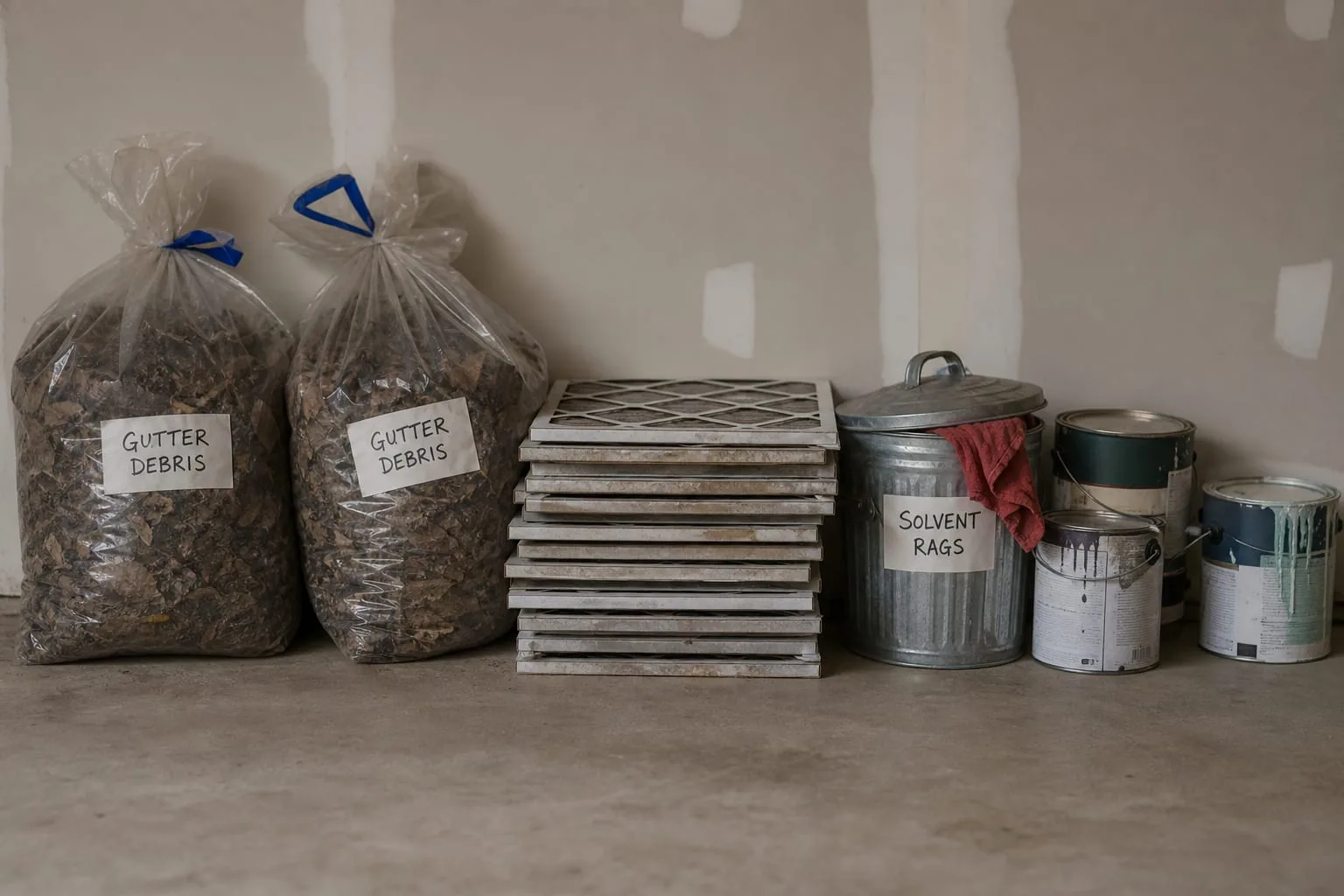
A gutter cleaning is ninety minutes of work and roughly two contractor bags of wet grit, shingle granules and rotted leaf mash that weigh far more than they look. Your hauler may take them, or may refuse them as yard waste in a season when yard waste is collected separately, or may take them and charge the overage. That single uncertainty is why the job slides from October to November to spring. The labor was never the obstacle. The obstacle was the twenty minutes of figuring out where the bags go, repeated every time the task comes around.
The cost of a task is the labor plus the exit
Price out a year of ordinary upkeep and the visible numbers are small: furnace filters, a water heater flush, a dryer vent brush, a chimney sweep, a softener refill, gutter work. What moves the total is the exit path for what each job produces. A furnace filter is trash almost everywhere and costs nothing to remove. Five gallons of sediment-laden water from a heater flush is fine down a floor drain in one town and a problem in another with a combined sewer under a discharge order. Chimney sweeps typically carry the soot away in the price, which is worth confirming, because soot left in a bucket on your patio becomes your disposal problem at their hourly rate.
The pattern repeats across the calendar. Deck refinishing generates half-empty stain cans, solvent-soaked rags that are a genuine fire risk in a closed garage, and a plastic sheet of dried overspray. Repainting an interior leaves latex that most transfer stations accept only after it has been dried out with hardener or kitty litter, which takes days you did not budget. Replacing a toilet leaves a porcelain fixture that curbside will not touch and that many stations weigh as construction debris at a per-ton rate with a minimum charge. None of these are expensive. All of them are inconvenient in a way that reliably kills a schedule.
Four kinds of leftovers, and only one of them is easy
Sort every recurring task by what it leaves behind and the calendar sorts itself. The first category is ordinary trash: filters, brush heads, spent caulk tubes, worn weatherstripping. Do those tasks whenever you like, because the exit is your regular Tuesday. The second is bulky or heavy material that goes to a transfer station or a scheduled bulk pickup: old fixtures, a dead dehumidifier, torn carpet, pressure-treated offcuts. Those tasks want to be batched, because you are paying for a trip and a minimum load whether the truck bed is full or nearly empty.
The third category is household hazardous waste, which is where most people's good intentions stall. Paint, stain, thinner, pool chemicals, driveway sealer, pesticide, motor oil, antifreeze, fluorescent tubes and lithium batteries all have restricted routes, and the Environmental Protection Agency oversees the framework that states and counties build those collection programs on. Many places run collection events a handful of times a year rather than continuously. The fourth category is regulated service waste, meaning refrigerant, asbestos-containing tile or pipe wrap, and lead-painted components, where the disposal is not yours to arrange at all and the licensed contractor's price includes it.
The same chore, two towns, two different prices
Local rules do more to shape a maintenance budget than anything on a product label. A house on septic in a county with a mandatory pumping interval has a fixed, non-negotiable line item every few years, and the hauler's price moves with tank size, access distance for the hose, and how far the truck drives to a treatment plant that will accept the load. A house on sewer has no such line and instead may face an annual backflow preventer test required by the water utility, performed by a certified tester whose fee is a fraction of a pump-out. Neither household can adopt the other's calendar.
Waste pricing splits the same way. Communities on unit pricing sell bag tags or stickers, so every cleaning project has a per-bag cost you can feel, and residents there tend to do fewer, bigger purges. Communities with unlimited curbside and a free residents-only transfer station make the same purge nearly free but cap you at a card check and posted hours, often two weekday mornings and a Saturday. Seasonal yard waste bans, common where landfill diversion is state policy, mean leaves and gutter debris are collected only in defined windows. Miss the window and the bags sit in the garage until spring.
Build the schedule backward from the collection dates
Start with the fixed dates you do not control: the two or three hazardous waste collection days, the bulk pickup weeks, the yard waste season, the transfer station hours, the septic interval or the backflow test month. Write those down first. Then place each maintenance task in the four to six weeks before its matching disposal date, so the leftovers never sit longer than a month. Painting the trim in the two weeks before a hazardous waste day is a different task than painting it in January with a shelf of half cans and no destination.
Batching does the rest of the work. One transfer station trip should carry the old fixture, the torn screen door, the dead dehumidifier and the drum of dried latex together, because the fee structure rewards it and the trip is the part you resent. Keep a labeled staging corner in the garage or basement, ideally with a metal can and a lid for anything solvent-soaked, and let it fill between runs. Households that hold a schedule for years almost always have that corner. It converts a dozen unpleasant errands into four predictable ones.
Call the town or county solid waste office once, ask what they accept, what they refuse, what the fees are and when the collection events fall, and put the answers somewhere you will find them next year. That call is fifteen minutes and it prices out an entire year of upkeep more accurately than any product estimate. Everything after it is just doing the work on a day when the leftovers have somewhere to go.