Re:Corporate
Renting Space in Someone Else's Warehouse? The Party Whose Costs End Up on Your Invoice
Dated5 min read
Third-party fulfillment quotes price receiving, storage and pick-and-pack. The waste hauler behind the building prices everything those three numbers leave out.
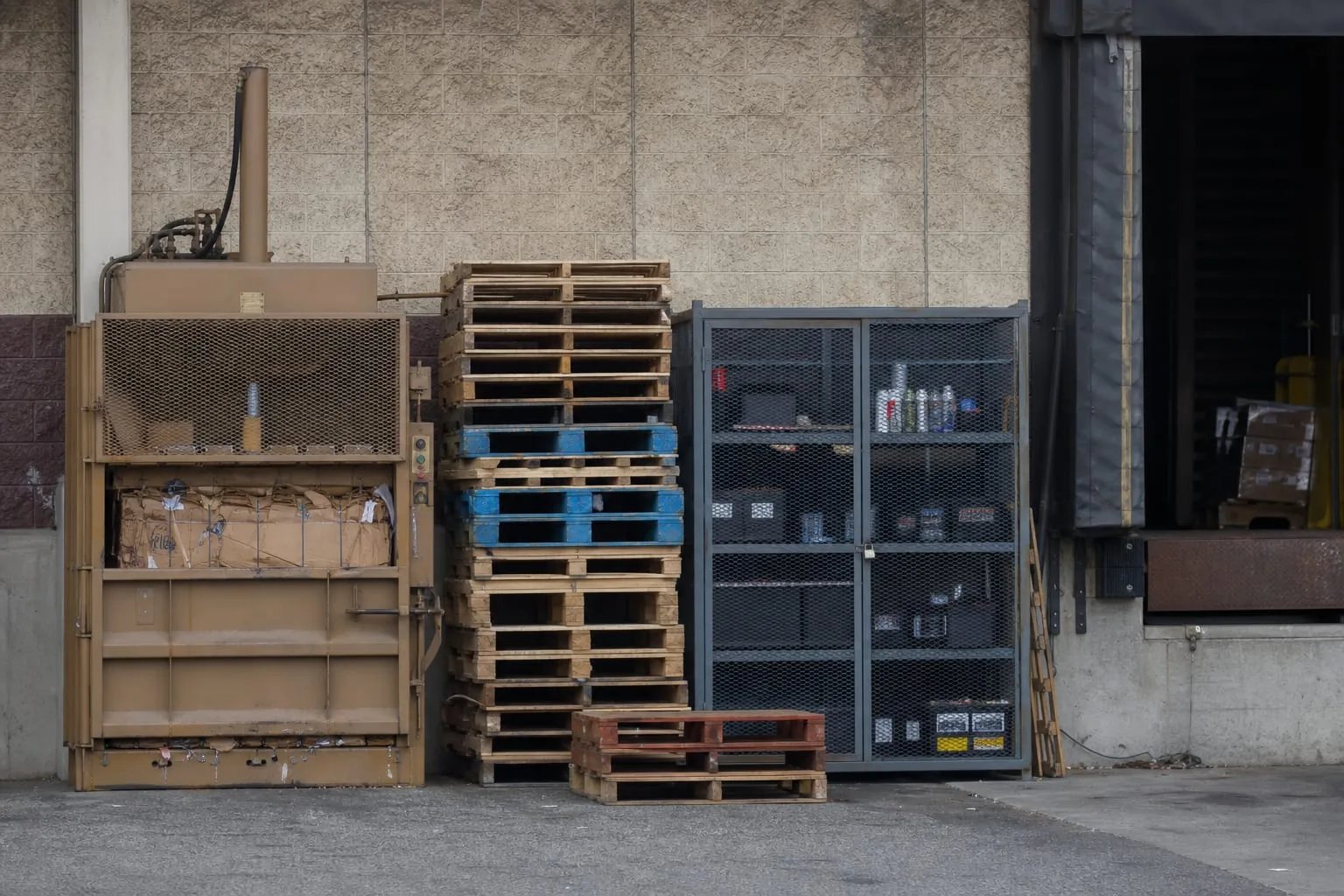
A fulfillment quote almost always arrives as three numbers: a receiving charge per pallet or carton, a storage charge per bin or square foot per month, and a pick-and-pack charge per order with a per-item adder. Those three numbers are easy to compare across bidders, which is exactly why they get compared, and why the differences between good and bad arrangements rarely show up in them. What separates a warehouse that will still suit you in two years from one that will not is the handling of everything that leaves the building without being an order. Cardboard, film, pallets, broken goods, returns, and the small category of items that cannot legally be thrown away at all.
Everything that comes in has to come back out
Freight arrives wrapped. A container of forty pallets brings forty pallets of stretch film, forty pallets of wood or plastic, corner boards, desiccant packs, and the outer cartons that get cut open and flattened before your units ever reach a bin. None of that is inventory, but all of it occupies the dock until someone pays to move it. In a warehouse you own, that cost is a line on your own utility statement and you feel it monthly. In a third-party building it is buried, either in an overhead allocation you never see, or in a per-carton receiving fee that quietly assumes your freight looks like everyone else's. It usually does not.
The judgment you are trying to build starts here, with a simple habit: for any product you are about to move into someone else's building, describe the trash it generates before you describe the sales it generates. A case of ceramic mugs in molded pulp is a different waste stream from the same case in expanded polystyrene, and the second one costs more to get rid of because it is light, bulky, and refused by most mixed recycling programs. That difference does not appear in a rate card. It appears in the first invoice with an accessorial you did not budget for.
The party nobody names in the contract
Your fulfillment agreement is between you and the operator. Behind it sits a second agreement nobody shows you, between the operator and a waste and recycling contractor, priced on container size, pull frequency, tonnage, and contamination penalties. That hauler sets the ceiling on what your operator can absorb without repricing you. When a 3PL suddenly introduces a disposal fee, or refuses to accept a product line it accepted last year, or starts charging for pallet removal that used to be free, the change almost never originated inside the warehouse. It originated in a renegotiated hauling contract, a recycler that stopped taking mixed film, or a landfill that raised its tipping fee.
Which makes the hauler worth asking about directly, and the question is not intrusive. Ask who hauls, how often the compactor or the baler runs, whether cardboard is baled and sold or thrown into a mixed container, and whether the building has a pallet buyer or pays to have pallets taken. An operator that bales and sells corrugated has a revenue stream that offsets your receiving cost. One that compacts everything together has a cost that will eventually find you. Both are legitimate operations. Only one of them will hold its price when your volume triples.
What cannot go in the dumpster, and who is liable when it does
Certain items in ordinary consumer inventory are regulated when they are discarded, not when they are sold. Lithium batteries and the devices containing them, aerosols, some cleaning chemistry, pesticides, mercury-containing lamps, and most electronics fall into categories the Environmental Protection Agency oversees under hazardous and universal waste rules, with state programs that are frequently stricter than the federal floor. A damaged case of rechargeable devices is not a write-off you can wheel to the compactor. It is a disposition event with a paper trail, a licensed receiver, and a bill.
Ask the operator, before you sign, what happens to a crushed carton of your regulated product at nine at night on a Friday. The useful answer names a physical location in the building where the item goes, a person who logs it, and an outside vendor who collects it. A vague answer, or one that begins with an assurance that it never happens, tells you the question has not been asked by a client before, and that the first time it does happen you will be the one negotiating a solution while your inventory sits in a corner. Operators who handle battery-powered goods routinely will answer this in one sentence.
Returns are a waste stream wearing a friendlier name
Every returns program is a disposal program with a resale option attached. The unit comes back, someone opens it, and a decision gets made: restock, refurbish, liquidate, donate, or destroy. Most contracts price the inspection and skip the rest, which means the four outcomes that are not restocking get resolved informally until the volume becomes visible. Decide the policy yourself and write it in, including the threshold below which a unit is destroyed rather than inspected twice, and the destination for goods that cannot be resold.
Do this before peak season rather than during it. A returns backlog occupies floor space you are paying for by the month, which means unmade decisions convert directly into storage charges, and the conversion is quiet enough that it can run for two quarters before anyone notices the bin count creeping up.
How to test all of this in an afternoon
Visit the building and stand at the back of it, not the front. The dock doors and the trash yard will tell you in twenty minutes what a proposal cannot: whether the baler is running or jammed, whether pallets are stacked and sorted or scattered, whether the regulated waste cage is locked and labeled or improvised. Ask to see last month's outbound waste tickets. An operator running a tidy back yard is running tidy inventory, because the same discipline produces both, and that is the strongest signal available to a buyer who cannot audit a warehouse management system.
Then price your own product's exit. Take one week of expected receipts, count the pallets and the film and the outer cartons, add a realistic damage rate, and ask each bidder what that specific week costs to dispose of. The bidders who can answer with numbers are the ones who have already had the conversation with their hauler, and their quote will hold.