Re:Money
Ring Needs Sizing or a Prong Rebuilt? What Changed at the Bench in Ten Years
Dated5 min read
Jewelry repair moved from the storefront bench to central shops with laser welders and cast parts, which changes the intake, the timeline and what is worth fixing.
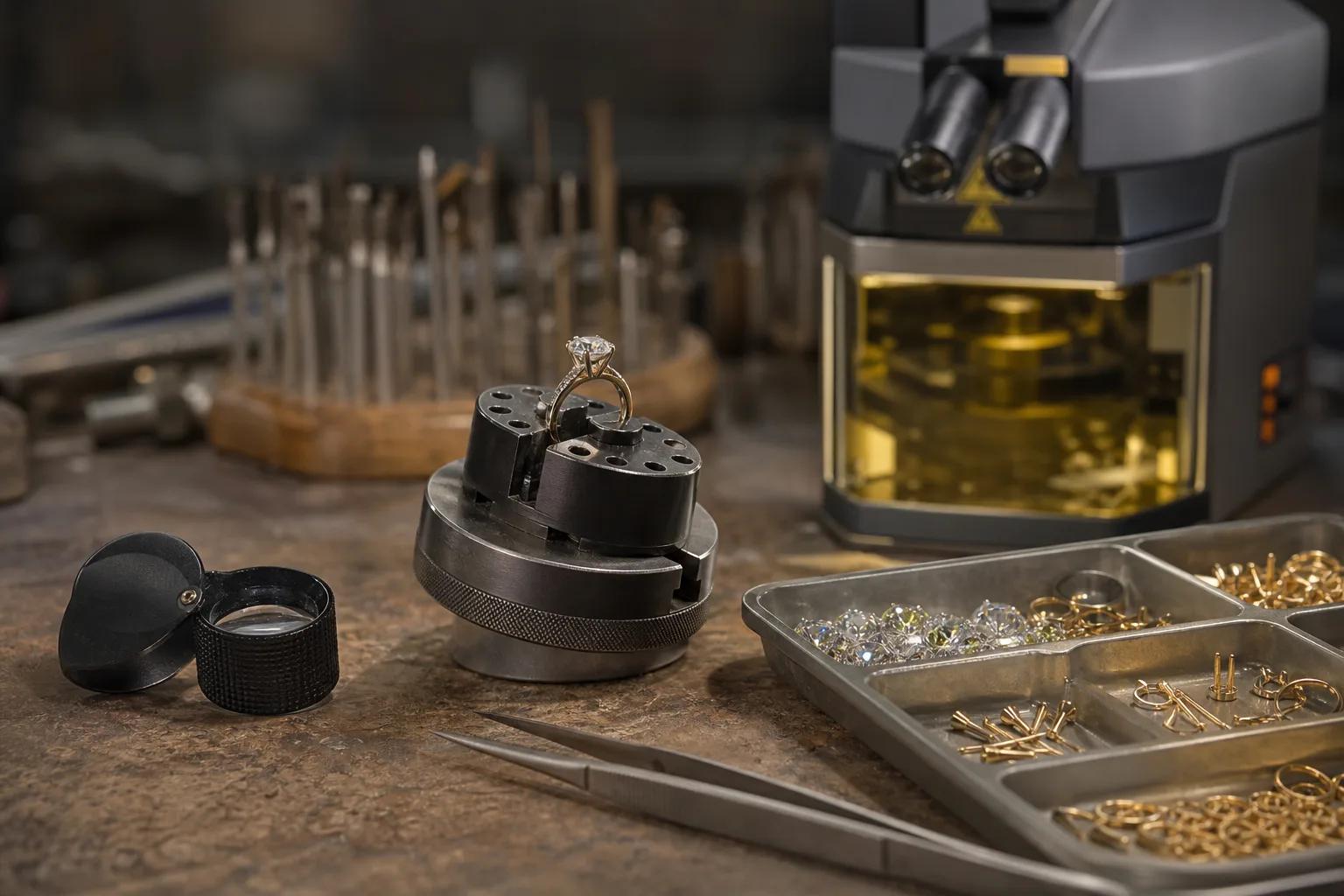
A worn shank, a prong that snags on a sweater, a chain that parted at the solder joint: these were counter conversations ten years ago, held with a person who was going to do the work himself, usually within sight of the register. That arrangement still exists, but it is no longer the default. Most repair intake in the United States now happens at a counter that is a collection point, and the actual work happens somewhere else, in a central shop with equipment no single bench could justify. The change is worth understanding before you hand anything over, because it alters the timeline, the paperwork and the answer to what is worth fixing.
The tools arrived before the workflow changed
The single piece of equipment that redrew this trade is the laser welder. A torch heats a whole area, which means stones come out first, enamel is at risk, and anything with a closed back has to be vented or it explodes. A laser puts a weld the width of a pencil line exactly where the operator aims it, with heat that dissipates before it reaches a seat an eighth of an inch away. Prongs get retipped with the diamond still set. Eyeglass frames, memorial pieces, hollow beads, all things that used to be declined outright, became routine. The machines cost enough that a solo bench with steady but modest volume struggled to buy one, and a regional shop running work for forty storefronts did not.
Casting followed the same logic. Ten years ago a replacement head or a custom shank was fabricated by hand from wire and sheet, which is skilled, slow work. Now the shop scans or models the part, prints it in castable resin, and casts it in the matching alloy, often overnight. What used to be a two-week fabrication became a three-day turnaround, and the part fits better because it was modeled against the actual geometry rather than eyeballed. Hand fabrication has not disappeared and remains the better answer for period pieces and unusual alloys, but it is now the exception a shop chooses rather than the only route available.
Where your ring actually goes after you sign the envelope
Ask the person at the counter one question: does the work happen on site, and if not, where. Neither answer is wrong. A central shop that handles thousands of pieces a month has a laser, a caster, a stone setter who sets all day, and a polisher who does nothing else, and that specialization usually produces better work than one generalist doing all four jobs between customers. What you are buying with a local bench is access, the ability to stand there while the jeweler puts a loupe on the piece and tells you what he sees. What you are buying with a larger provider is equipment depth and a process built to not lose things.
The process is the part people underrate. A serious repair operation photographs the piece at intake, records stone count, weighs it, notes existing damage, and attaches a tracking number that follows it through every station. Transit is insured. The envelope is sealed in front of you. If a melee stone is missing when it comes back, there is a photograph from before it left the store, which is a far better position than a memory and a receipt. Ask to see the intake photographs. A shop that takes them will show you without hesitation, and that willingness tells you most of what you need to know about the rest of the operation.
What the metal will and will not allow
A great deal of the resizing conversation now turns on materials that barely existed in the wedding band case a decade ago. Tungsten carbide, ceramic and cobalt cannot be sized at all, because they are not worked, they are ground to shape and would shatter or burn. Titanium can sometimes be stretched a fraction but will not take solder in the ordinary way. Many retailers who sell these bands handle it with a lifetime exchange rather than a repair, which is a reasonable answer as long as you know it is the only answer. Silicone, now common on job sites, is disposable by design. The practical result is that the question at the counter has shifted from how much to size it toward whether it can be sized.
Precious metals still behave the way they always did, with a few wrinkles. Platinum needs a hotter torch and its own solders, and a shop set up only for gold will send it out. White gold is rhodium plated, so any sizing or repair means the whole ring gets replated, which is why a simple job comes back looking newer than you remember and why that finish will wear off the high points again in a year or two. Solder should match the karat of the piece, and a reputable shop will tell you which it used. The Federal Trade Commission oversees how precious metal content is described and advertised in this country, which is why a quality stamp and a jeweler's willingness to name the alloy are not trivial details.
The damage that is worth money and the damage that is a replacement
Retipping prongs is close to always worth it, because the alternative is a lost center stone, and the cost sits far below the deductible on most scheduled jewelry coverage. A shank worn thin enough to flex under thumb pressure is worth replacing, and a half shank costs a fraction of a new mounting. A chain that broke at a link is a five minute laser weld. A chain that is breaking in several places has work hardened along its length and will keep breaking, which makes each repair a payment toward a replacement you have not decided on yet. Pearl restringing with knots between each pearl is cheap insurance and should be on a schedule, not a crisis.
The line gets harder with castings that have thinned overall, filigree that has been repaired three times already, and mountings where the metal around the seats has been polished away until the prongs sit on nothing. A good bench will say so, and will usually offer to pull the stones and set them in a new mounting, which often costs less than the accumulated repairs would. That is the moment where a larger provider's casting capability pays, because a new mounting modeled on the old one can preserve the look you actually care about while giving the stones metal that will hold them.
The search, and what an instant yes tends to mean
The benches worth finding are booked, and they sound like it. Someone who quotes a firm price and a firm date without examining the piece under magnification, with the stones tightened and checked, is quoting from a menu rather than from the work. An immediate yes to a complicated job, particularly on enamel, an old European cut, or anything with a closed back, is worth one more question about who is doing it and on what equipment. Ask for the shop's repair policy on stones lost in process, ask whether the appraisal value is documented before it leaves, and ask what happens if the finish does not match. Three questions, plainly answered, sort the field quickly.
Two weeks out with a written intake and photographs beats tomorrow afternoon with a handshake, almost every time.