Re:Money
Three Exclusions You Can Buy Back, One You Cannot, and How to Tell Them Apart
Dated3 min read
Most exclusions in a homeowners policy are routing devices rather than refusals, and the differences between them decide what you can still add before a loss.
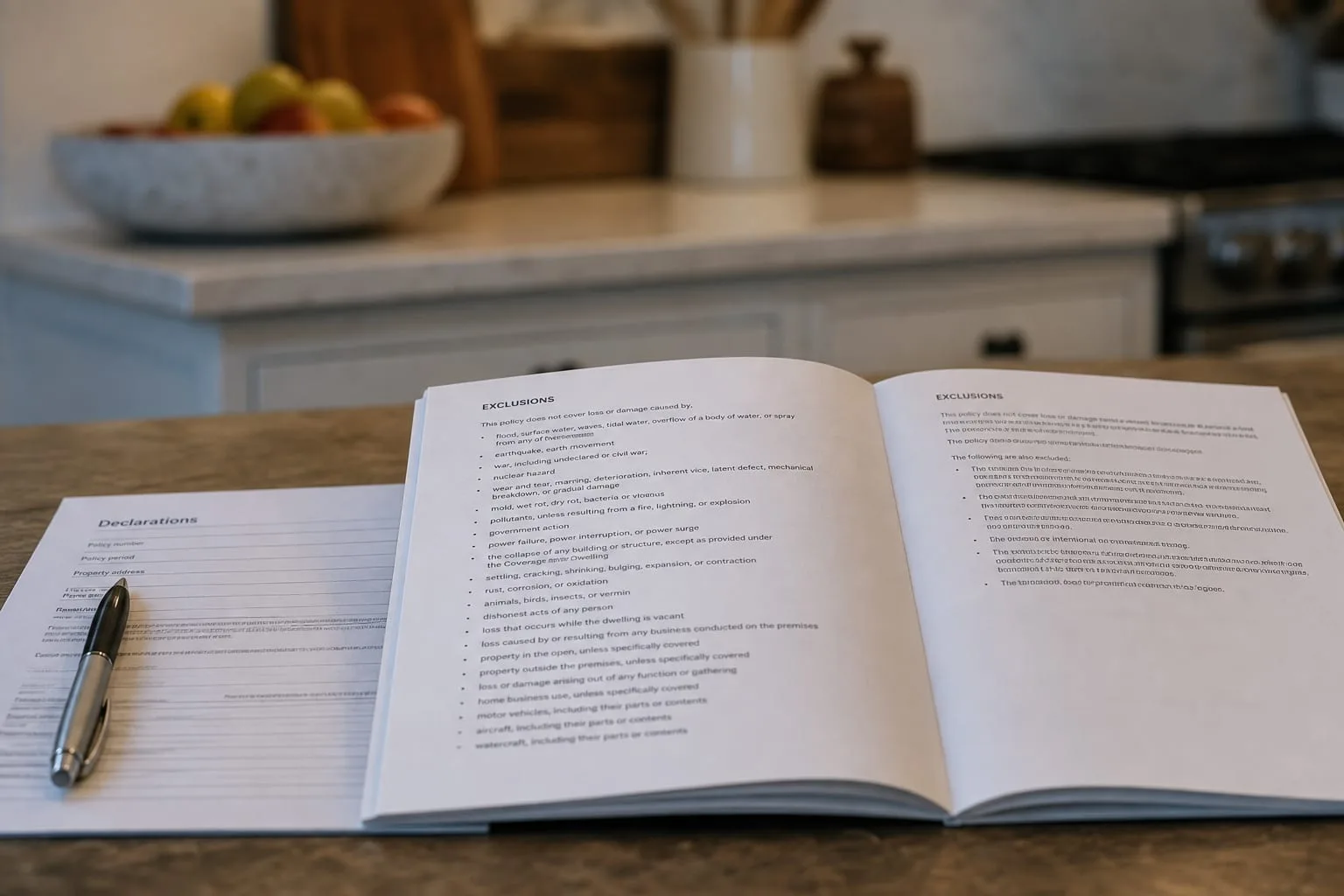
People who read policies for a living do not open at the front. They go to the exclusions, then to the endorsement list stapled behind the declarations, then back to the insuring agreement, because that order tells you what the contract is actually buying and what it has quietly handed to somebody else. The common assumption is that an exclusion exists to give the carrier an escape hatch after a loss. That is the wrong picture. Most exclusions are routing instructions written before anyone knew your name, and a good share of them can be reversed for money while the house is still dry.
A router, not a refusal
An unrestricted policy would have to price every peril for every house, including the ones a small fraction of buyers face and the rest would rather not fund. Exclusions carve those out so the base form can be sold at a rate that matches an ordinary risk. What happens to the carved-out peril varies, and that variation is the whole game: some perils move to a separate policy, some move to an endorsement on the same policy, some are really a maintenance standard wearing exclusion clothing, and a few are simply gone. Four different mechanisms, four different remedies, one identical typeface.
The ones that move to a separate policy
Flood is the clearest case, and it is not a coverage gap so much as a jurisdictional line: the peril lives in a different contract, sold under a different program, priced off elevation and map zone rather than roof age. The Federal Emergency Management Agency oversees the federal flood insurance program, and private flood markets have grown alongside it. Earthquake behaves the same way in most states, as do sinkhole and mine subsidence where geology makes them relevant. The remedy here is never an argument with an adjuster. It is a second policy, bought in advance, usually with its own waiting period before it does anything.
The ones that are really a maintenance standard
Wear and tear, deterioration, rust, rot, settling, and seepage over a period of time are grouped as exclusions, but read them as a definition of the line between an accident and a condition. A supply line that lets go at three in the morning is an event. The same fitting weeping behind a vanity for eight months is a condition, and the policy declines to fund deferred maintenance no matter how the water eventually arrives. Repeat readers spot the tell instantly: the phrase continuous or repeated, and a stated span of days. That span is the whole test, and the resulting damage language after it often restores coverage for what the sudden failure ruined.
The ones sold back to you for a few dollars
This is the category most households never learn about, because nothing prompts the conversation. Water backing up through a sewer or drain, or overflowing from a sump when the pump quits, is excluded on the base form and added back by endorsement at a stated limit. Service line coverage does the same for the buried water, sewer, and electrical runs between the street and the house, which are the homeowner's problem in most jurisdictions. Ordinance or law pays the gap between rebuilding what burned and rebuilding what the current code now requires, which on an older house is not a rounding error. Mold, hidden decay, and equipment breakdown follow the same buy-back pattern.
The ones that stay closed, and how to sort them in an afternoon
Intentional loss, war, nuclear hazard, government seizure, and, on most forms, damage caused by insects, birds, or rodents are not for sale at any premium, and no amount of shopping changes that. Sorting your own policy is a two-hour job with the declarations page, the full form, and a pen. Read every exclusion, and for each one write which of the four it is: separate policy, maintenance standard, buy-back, or closed. Then call your agent with the buy-back list only, and ask for the endorsement name, the limit, and the added annual premium in writing. An instant yes, you are covered, delivered without a pause to open the form, usually means the question was heard as reassurance rather than as a request. Ask again in an email.
The households that come through a loss cleanly are rarely the ones with the largest policies. They are the ones who did the sorting exercise on a slow Sunday, added the two or three endorsements that matched their actual house (a finished basement, a fifty-year-old sewer lateral, a town that updated its code twice since the roof went on), and knew before the truck arrived which paragraph the claim would land in. That reading takes one afternoon and holds for years, needing only a fresh look when the renewal form changes or the house does.