Told the Drying Would Take Three Days? What the Second Crew Found Behind the Baseboard
Dated4 min read
A failed water heater, two restoration outfits, and one instant yes. What separated the fast answer from the correct one was a meter reading nobody had taken yet.
The water heater sat in a hall closet on the first floor of a split-level, and when the tank seam let go on a Tuesday afternoon it emptied across oak flooring, under two walls, and into the finished room below the stairs. The homeowner called five restoration numbers that evening. Three did not answer. One took a message. The fifth answered on the second ring, promised a crew before nine the next morning, and quoted a three-day drying schedule sight unseen. That speed felt like competence. It was, in the end, the part of the job that had to be undone.
What the instant yes was actually promising
A same-night yes from a restoration contractor in a week without a regional storm usually means one of two things: the outfit is genuinely local and quiet, or it is subcontracting the work to whoever has equipment free. Neither is disqualifying. What matters is what the yes covers. In this case the three-day figure was not a measurement, because nobody had been in the house. It was a rental cycle. Equipment goes out, equipment comes back, and the schedule that gets quoted on the phone is frequently the schedule that keeps the trailer turning rather than the one the building requires.
The homeowner kept calling. The second firm that answered was a larger regional provider with several crews and a dispatcher instead of an owner with a cell phone. They could not come until the following afternoon, and they declined to give a number of days over the phone. They said the drying period would be set by readings taken on site and would be reviewed each morning. That answer sounded slower and less reassuring. It was the one worth waiting for, and the intervening hours were spent pulling wet contents off the floor.
The equipment does one job, and the building decides how long
Air movers do not dry anything. They push moisture off surfaces and into the air, and a refrigerant dehumidifier, the low grain refrigerant type common on residential losses, pulls it back out and drains it. That loop only works on water the air can reach. Water that has wicked up the paper face of gypsum wallboard behind a painted baseboard, or sat in the void between a subfloor and a hardwood plank, is not in the airstream at all. A room can feel dry, smell dry, and read dry across every exposed surface while the cavity behind the trim stays wet for weeks.
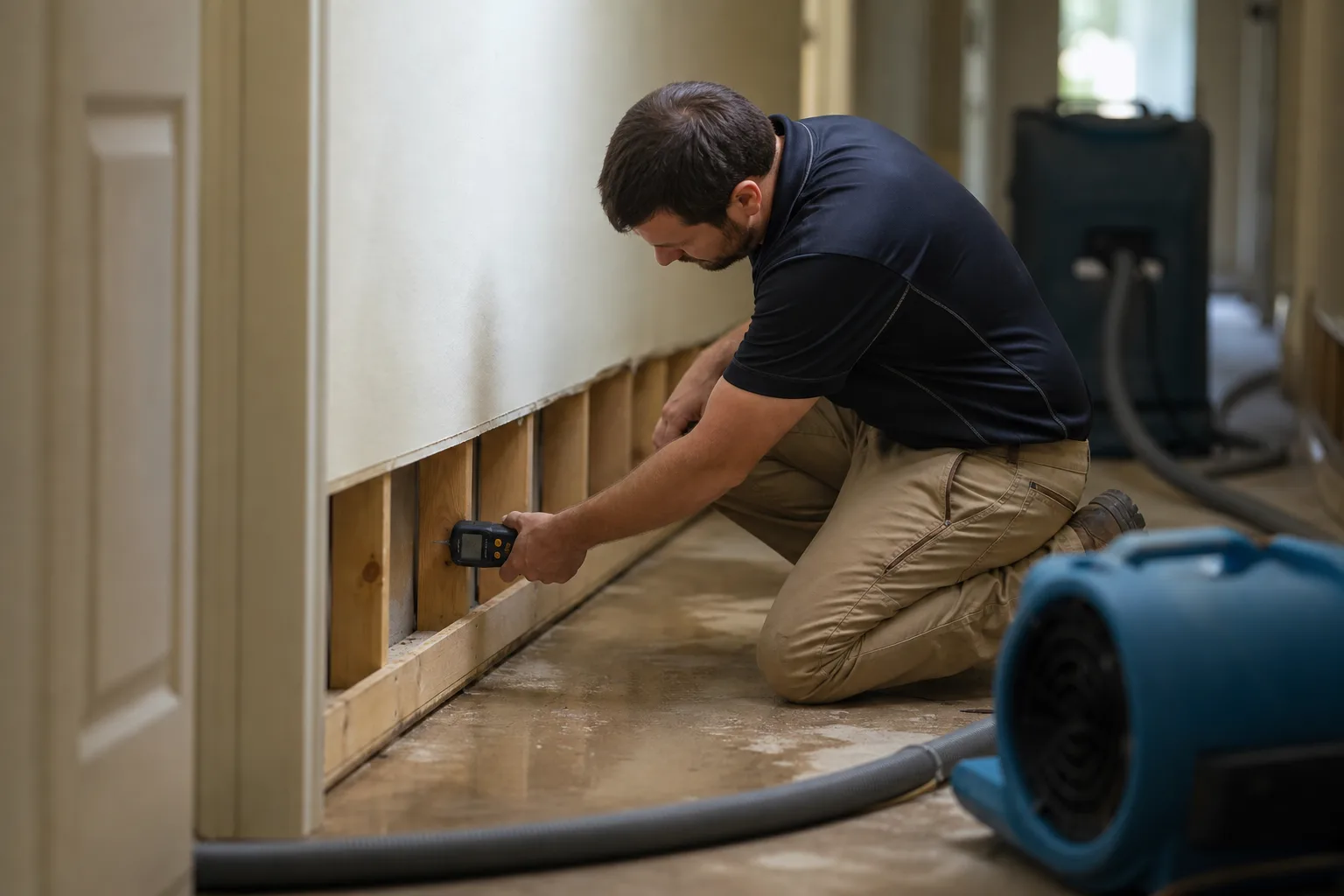
The second crew came in with pinless meters for scanning and pin meters for confirmation, a thermo-hygrometer for the ambient readings, and a small drill. They pulled the baseboard on both wet walls, drilled a line of holes into the bottom plate cavity, and set a cavity drying system to force air behind the drywall rather than across it. The oak flooring got mats and a vacuum unit. None of that equipment was exotic. It was simply the equipment that matched where the water had actually gone, which is a question that requires standing in the house to answer.
The readings that settled the argument
A dry standard is a reading taken from unaffected material of the same kind elsewhere in the house, and it is the only honest target. Wood in a Midwestern basement in November is not supposed to read the same as wood in a Phoenix attic in July. The crew logged a reference reading from a closet wall that never got wet, then logged the affected points each morning against it, same spots, marked in pencil on the studs so the next technician measured the same square inch. That log is the difference between drying and running fans.
The affected wall plates came down slowly. Surfaces reached the target in roughly three days, which is exactly what the first firm had promised, and the cavity readings were still high enough on day four that the equipment stayed. The Environmental Protection Agency is responsible for federal guidance on moisture and mold in buildings, and the principle underneath all of it is the plain one: material that stays wet past a few days starts to support growth, and material sealed behind finished trim is the material most likely to stay wet without anyone noticing.
Why the larger provider wrote it down differently
Scale changed the paperwork more than it changed the crew. A firm running multiple trucks cannot rely on one technician's memory, so the daily moisture log, the equipment count, the psychrometric readings, and the photographs went into a file that the adjuster could read without a phone call. That file did two things. It justified the extra days of equipment to the insurer, which is the point at which a short drying schedule usually gets defended by the contractor who wrote it, and it gave the homeowner a record showing the walls reached target before the drywall was closed up.
The two estimates, incidentally, landed within a few hundred dollars of each other. The gap was not price. It was whether the completion date came from a rental calendar or from a meter.
What to ask while the good crews are still booked
Ask how the end of the job is determined, and listen for whether the answer contains the phrase dry standard or something like it. Ask whether baseboard is coming off and whether cavities will be checked, because a crew planning to dry only what it can see will tell you so plainly if asked. Ask for the daily log by email. A firm that is genuinely busy will often give you a later start date and a straight answer about method, and that combination is more reliable than an arrival time tomorrow with a finish date already attached.
The closet wall was opened in the end, patched, and repainted in a single afternoon. Nothing came back through the paint the following spring, which is the only result the whole exercise was ever trying to buy.