A Towel Under the Sink for Two Years, and the Disposal Bill That Followed
Dated6 min read
A first-time owner's slow sink leak cost almost nothing to stop and a great deal to haul away, and the haul-away rules are not what they were ten years ago.
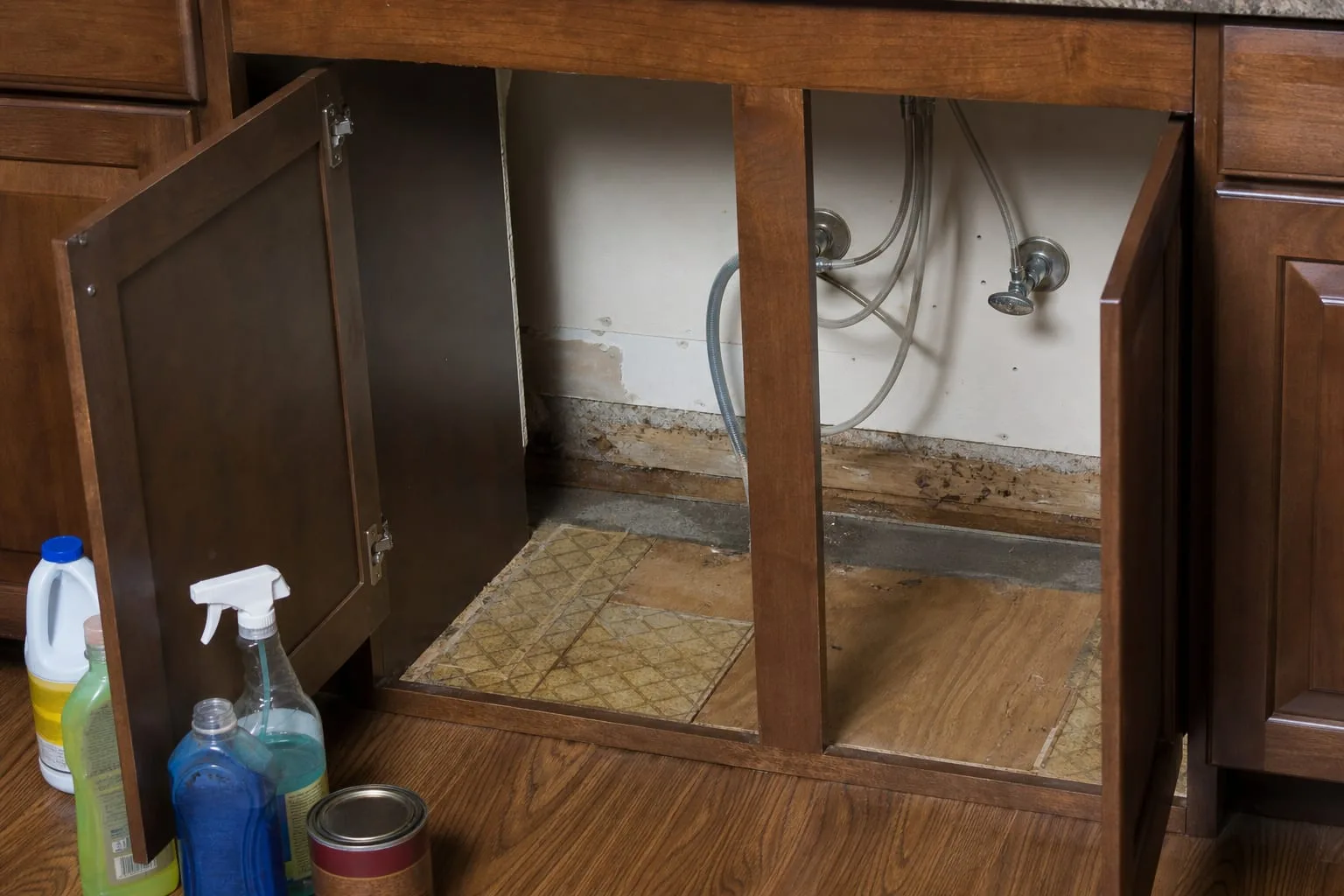
The leak itself turned out to be the cheapest part of the job, corrected in about four minutes with a wrench, a new nylon compression sleeve, and a strip of thread tape. What cost money was everything the water had touched on its way down, and then, larger than anyone expected, what it cost to make that material legally disappear. The owner was a first-time buyer, two years into a 1968 ranch, and had done what most people do with a dark ring on the cabinet floor: put a folded towel under it and checked back on weekends.
The case: one drip, two years, four materials
The drip came from the cold supply at the shutoff, maybe a teaspoon an hour, never enough to pool. It landed on the particleboard cabinet deck, which drank it, swelled, and then stayed swollen. Water that reaches the back corner of a sink base does not stop there; it follows the deck to the toe kick, crosses under the cabinet, and gets into the seam where the sheet vinyl was cut to fit the cabinet run. By the time a plumber was called for a separate problem, the pressure of a hand on the cabinet floor pushed through it, and the smell in the closed cabinet was the kind that does not come out.
The demolition was small in square footage and awkward in composition. Out came the sink base carcass, wet particleboard with a melamine skin, which cannot be dried and reused because the fibers have already lost their bond. Out came a strip of sheet vinyl and its mastic, roughly three feet by six. Out came the top layer of subfloor, quarter-inch underlayment plywood delaminated in sheets, and beneath that a patch of the original diagonal plank decking that was stained but sound. And out came the contents of the cabinet, which is where the job stopped being carpentry.
What was under the sink, and where each thing had to go
Nobody plans the shelf under a kitchen sink. This one held drain opener, oven cleaner, two aerosol degreasers, a half gallon of deck stain that had migrated indoors, a bag of ice melt, and a rusted-through can of something whose label had lifted off in the damp. That collection is household hazardous waste, and it does not ride to the transfer station in the same load as the plywood. The corroded cans were the real problem, because a facility that accepts unknowns wants them identifiable, and an unlabeled quart of liquid gets handled as a lab pack rather than as paint. The Environmental Protection Agency oversees how household hazardous material is classified and managed, and the practical effect at the counter is that identification is your job, not the attendant's.
The vinyl raised the second question. Sheet flooring of that vintage, and the black mastic under it, is old enough that the felt backing may contain asbestos, which means it is not something a homeowner removes dry with a scraper on a Saturday and bags for the curb. The correct sequence is a sample to a lab, a result in writing, and then either an ordinary demolition or a licensed abatement with a separate disposal stream and its own manifest. That single sheet of flooring, three feet by six, decided whether the job was one trade or three.
The same decision in 2015, and the same decision now
Ten years ago this repair had a simpler back end. A small mixed load, cabinet box, plywood, flooring, a few cans, went into a ten-yard roll-off or one of the woven bags a big-box store sells, and the hauler took it on a single flat ticket to a transfer station that accepted mixed construction and demolition debris without asking much. The chemicals were the only thing that traveled separately, and even then, many people quietly buried them mid-load. The cost of the waste was a rounding error against the cabinet and the flooring, which is why the towel under the sink looked like a reasonable bet at the time.
The back end is different now, and the difference is structural rather than a matter of prices drifting up. Haulers increasingly bill by weight over an included allowance rather than by the box, so wet particleboard and saturated plywood, both of which weigh several times their dry selves, are charged for the water they are holding. More transfer stations reject genuinely mixed loads or apply a contamination surcharge that erases any saving from combining them. Paint and stain now move through stewardship collection points in a growing number of states rather than into the dumpster. And the flooring question, which used to be answered by a shrug, is now answered by a lab result, because the abatement contractor will not touch it otherwise and the landfill will not accept the material without paperwork.
So the identical physical repair, one shutoff and a patch of floor, arrives at a different total. The plumbing part is unchanged and trivial. The carpentry part has moved with lumber and cabinetry generally. The waste part has grown from an afterthought into a line with three separate destinations, a scheduling dependency, and a document. That is the compounding people miss when they think about deferred maintenance. It is not only that the damage spreads. It is that the material the damage creates has become progressively more expensive and more regulated to get rid of, so the same delay bought at the same price ten years ago settles at a higher number today.
What a first-time owner cannot see, and the two checks that catch it
The reason a towel feels sufficient is that a slow supply leak produces no drama. There is no ceiling stain downstairs, no meter spinning, no sound. A first-time owner has no baseline for what a cabinet floor is supposed to feel like, and particleboard hides its condition well until it fails all at once. The useful instinct to build is not vigilance about leaks in general but a habit around one specific surface, because the sink base is the single place in a house where a slow drip meets an absorbent material and a closed door.
Two checks do most of the work, and neither takes a tool. Once a season, empty the cabinet completely and press the deck with your palm in all four corners, particularly the back corner under the shutoffs, where a soft or spongy spot means water has been sitting long enough to break the bond. While it is empty, read the labels on everything you put back, and throw out anything you cannot identify at the next household hazardous waste collection day rather than storing an unknown for the next owner or the next demolition crew. A sheet-pan-sized plastic tray under the shutoffs turns any future drip into a visible puddle instead of a hidden one.
There is also value in learning the flooring question before you need the answer. If the house predates the mid-eighties and has sheet vinyl anywhere, finding out now what the backing is, from a lab and in writing, converts a future emergency into a scheduling problem. It costs very little as a standalone errand and a great deal as a discovery made with the cabinet already out and a crew standing in the kitchen. The same document also settles what your hauler can accept, which is the step that determines whether the debris leaves in one trip or three.
The plumber's line, delivered while tightening a fitting that had never been properly seated, was that the fix had been available for two years for under a dollar. What had changed in that time was not the leak. It was the pile it eventually made, and the number of separate places that pile now has to go.