Water in the House? The First Forty-Eight Hours Are Mostly About What Leaves It
Dated5 min read
The early hours after a water loss are usually described as drying. In practice they are a removal and disposal job, and a larger provider runs that part on paperwork.
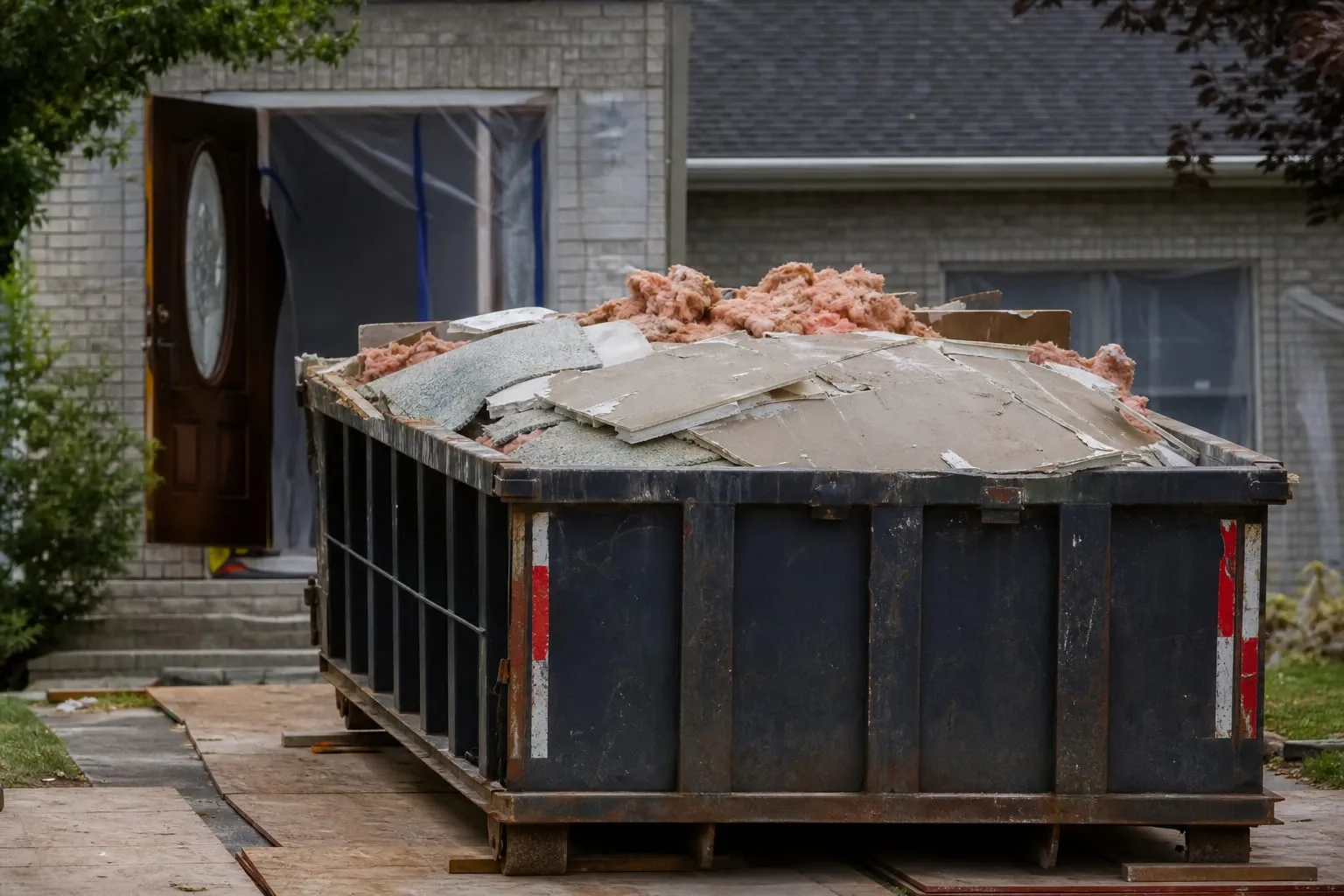
Most people are told that the first two days after a water loss are about drying, and the equipment supports that story: air movers stacked in the hallway, a dehumidifier running a condensate hose into the tub, a moisture meter pressed against the baseboard every few hours. Drying is real work, but it is the second half of the job. The first half is subtraction. Somebody has to decide what comes out of the house, cut it out, carry it down the stairs, and then find a legal place to put it, and that last part is where the money and the delays actually live.
The early hours are a removal job wearing drying equipment
Water travels down and sideways, and it soaks the cheapest materials first. Paper-faced drywall wicks upward from the floor plate. Fiberglass batts hold water like a sponge and give up almost none of it to airflow. Particleboard cabinet boxes swell at the toe kick and never come back. Carpet pad turns to gray mush within a day. A competent crew arriving in hour six is not primarily deciding how to dry those things, because most of them cannot be dried. They are deciding where to cut, how high, and how much of the house becomes debris by Thursday.
That decision sets your whole timeline. Cut two feet of drywall around a great room and you have created maybe forty sheets of wet gypsum, a few hundred pounds of soaked insulation, and a floor covering that has to come up before anything underneath it will read dry on a meter. Cut a conservative eight inches and you may be back in three weeks reopening the same wall. The first forty-eight hours is where a provider commits to one of those two futures, usually before an adjuster has walked the property.
What cannot go in the dumpster, and who finds out first
Wet building material is heavy, and heavy waste is priced by the ton at the transfer station, which is why the dumpster on the curb is a cost center rather than a convenience. Beyond weight, some of what comes out of an older house is not ordinary construction debris at all. Nine-inch vinyl floor tile and the black mastic under it, sheet flooring with a felt backing, pipe wrap and boiler insulation, and some textured ceiling finishes may contain asbestos, and none of it can be ripped up on a hunch. Painted trim in a pre-1978 house brings lead into the conversation.
Then there is the household layer, which nobody budgets for. Half-used paint and thinner in the basement that got wet and tipped over. A freezer of thawed food. A submerged furnace with a control board and a mercury switch. Electronics, batteries, fluorescent tubes, a dehumidifier with refrigerant in it. Every one of those has a separate route, and the routes are local: household hazardous waste days, an appliance recycler who pulls the refrigerant and issues a certificate, an e-waste drop that will not take a television with a broken screen. The Environmental Protection Agency oversees how these material streams are handled, and the practical effect is that a crew cannot simply consolidate everything into one load.
What a larger provider is actually doing with the paperwork
The visible difference between a two-truck operation and a regional restoration company is the truck count. The real difference is documentation, and it shows up in the first two days. A larger provider sends a technician who photographs each room before the first cut, logs moisture readings by location, sketches the affected area with dimensions, and records what material is being removed and how much of it. That file is what the insurer's estimating software prices later. Without it, the argument about whether forty sheets of drywall came out of your house is your argument to lose.
Waste gets the same treatment. A serious outfit keeps weight tickets from the transfer station, manifests for anything regulated, and disposal receipts tied to the job number, because those are billable line items and because the alternative is an adjuster disallowing them. If a suspect flooring material shows up, the firm has a relationship with a testing lab and can get a sample turned around fast, then bring in a licensed abatement subcontractor rather than pausing your job for a week while somebody finds one. Scale buys you the phone numbers, not just the equipment.
There is a containment side to this too. Cutting wet drywall in a house where people are still sleeping means poly barriers, zippered doorways, negative air with a filtered scrubber, and a path from the work area to the dumpster that does not run through the kitchen. Larger companies do this by default because their own crews are covered under workplace rules and because a cross-contaminated second floor becomes their problem to redo. It reads as fussy on day one. It is the reason the clean part of the house stays clean.
The five things to settle before anyone makes a cut
Ask where the cut lines are and why, in inches, room by room, and get it on the estimate rather than in conversation. Ask what is coming out of the house and what is staying, specifically whether cabinets are being removed or dried in place, because that single answer can swing a claim by five figures. Ask who is paying for disposal and how it is measured, tonnage or per-load. Ask what happens if a suspect material appears, and who holds the testing relationship. Ask what your own household items require, since those rarely belong to the restoration scope.
Photograph everything yourself before the crew starts, then again as walls open, and keep the images with timestamps intact. Save a cutoff of any flooring, tile, or trim that gets removed, labeled with the room, in a garbage bag in the garage. If a coverage dispute develops in month two, a six-inch sample of the original material and a photograph of it in place is worth more than a paragraph of recollection. Keep the disposal receipts your provider gives you rather than filing them as junk mail, because they are evidence of the quantity removed.
One more thing worth settling early: the dumpster's location and duration. Placement in a driveway can require plywood underlayment to protect the surface, placement in the street can require a permit from the city, and an overloaded box will not be hauled at all. A provider who raises these on the first visit is telling you something reliable about how the rest of the job will run.
The households that come out of a water loss cleanly are usually the ones that understood, by the end of day two, exactly what had left the building and where it went. That is a knowable list, written down while the work happens, and it is the spine everything later hangs on: the scope, the claim, the rebuild bid, and the final invoice.