Wet Carpet in the Driveway? What an Adjuster's Visit Actually Sets in Motion
Dated4 min read
The loss adjuster's scope decides what leaves your house, when it leaves, and who pays the tipping fee. Here is how that plays out across an ordinary week.
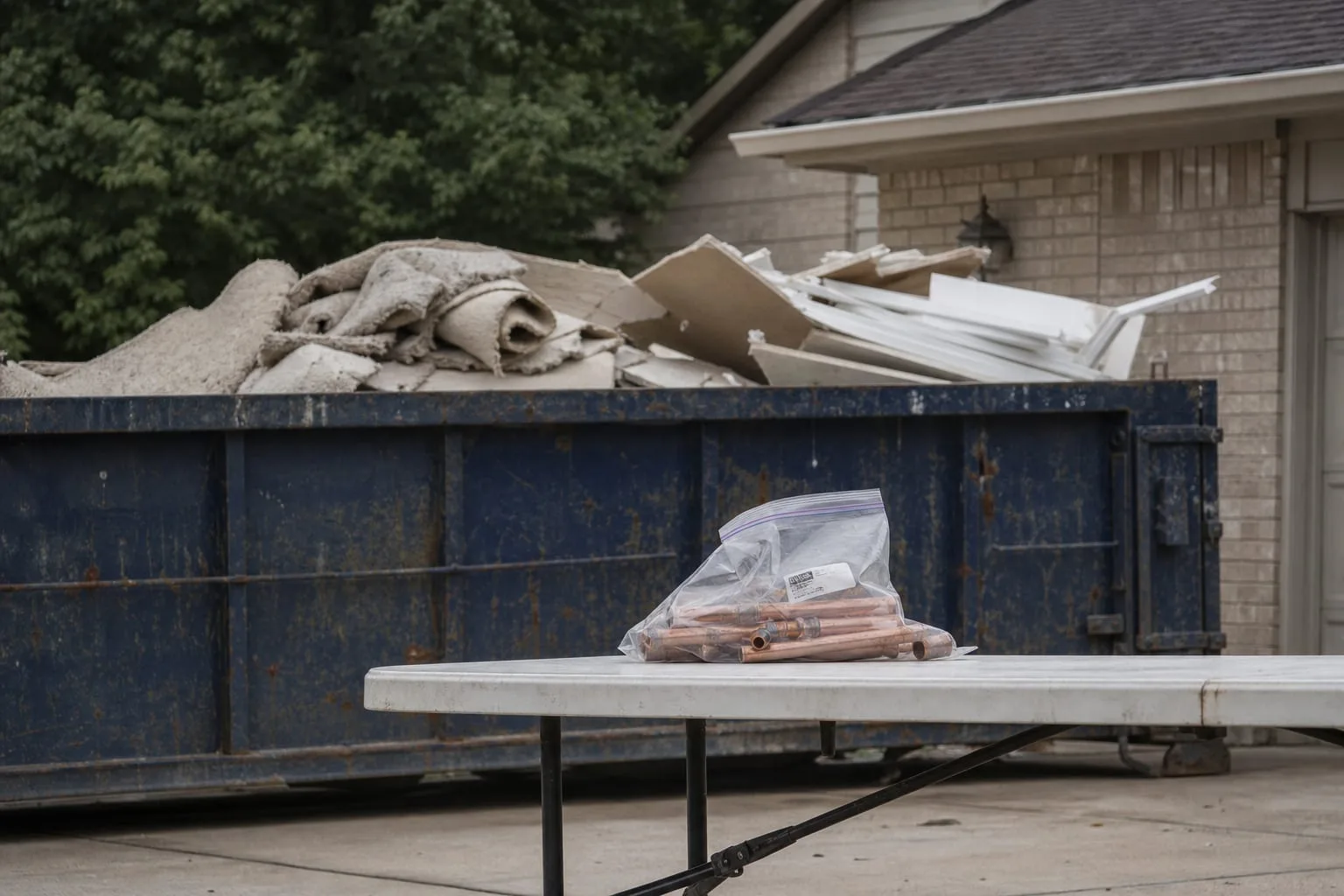
The first thing most people notice after a loss is not the paperwork. It is the pile. Carpet cut into strips, pad that has gone the color of weak coffee, baseboard stacked against the garage, and two feet of drywall that came off in sheets and is now sagging in the driveway. That pile is a direct product of decisions the loss adjuster makes, or has not yet made, and its size, its smell, and how long it sits there tell you roughly where your claim stands on any given Tuesday.
The scope is a disposal document before it is anything else
An adjuster's scope of loss reads like a construction estimate, and it is one, but read it from the back and it is a waste manifest. Debris removal appears as its own line, usually priced by the dumpster or by the hour, and separately from the demolition labor that fills it. Haul-off of a specific item, a soaked sectional, a refrigerator with spoiled contents, a mattress, often has to be listed by name to be paid. If those lines are thin, the money for tearing out arrived and the money for taking away did not, and someone will be standing in your driveway asking who is covering the second trip.
This is worth checking on the first pass rather than the third. Ask directly whether debris removal is written as a percentage of the repair total, a common approach, or as measured volume, and ask whether disposal fees at the transfer station are inside that number or billed separately at the scale. Restoration contractors know the difference immediately, and most will tell you plainly when the allowance is short. Getting it corrected while the adjuster is still writing costs a phone call. Getting it corrected after the check is issued costs a supplement, which is routine but slower.
What you are not allowed to throw away yet
The single most expensive mistake in the first week is hauling something off before it has been seen. Adjusters work from photographs and from physical evidence, and a failed supply line, a scorched outlet, a section of pipe with the split visible, is the proof that connects the damage to a covered cause. Cut it out, bag it, label it with the date, and put it somewhere dry. The same applies to flooring: keep a full plank or tile of everything removed, because matching material and grade is how the replacement line gets priced, and a photograph of a wet floor does not establish that the oak was three-quarter inch and site finished.
Contents are the other holding problem. Anything you intend to claim needs to exist, at least in photograph and inventory form, before it goes to the curb. A short video walking the pile, item by item, spoken aloud, satisfies most carriers and takes fifteen minutes. Then it can go. Adjusters are generally reasonable about health hazards, and nobody expects a household to store sewage-contaminated goods for two weeks, but the request to document first is not a formality, and a household that does it well tends to get paid for contents without an argument.
The material that cannot go in the dumpster at all
A roll-off is licensed for construction and demolition debris, and a transfer station will refuse the load, or surcharge it heavily, if it contains what the industry calls prohibited items. Latex and oil paint from the garage that got wet. Electronics. Fluorescent tubes and the ballasts they sit in. Any appliance holding refrigerant, which has to be evacuated by a certified technician before the shell is scrapped. In a house built before the early 1980s, nine-by-nine floor tile and the black cutback adhesive under it, and pipe insulation on old ductwork, may contain asbestos, and those get sampled, then abated under a separate licensed scope. The Environmental Protection Agency oversees how those materials are handled and disposed of, and no adjuster or contractor works around it.
The practical consequence is scheduling. Abatement is its own trade, its own permit, and its own week, and it sits between demolition and drying. Written into the scope early, it moves in parallel with everything else and the job barely notices. Discovered on day nine, when the drywall is already open, it stops the calendar. Ask about the age of the building materials during the first inspection and let the adjuster put testing in the estimate. It is a small line that protects a large one.
The week-to-week rhythm, and how to hold it
Living through a claim is mostly waiting punctuated by short windows where something must be answered the same day. The dumpster permit, if the roll-off sits in the street, comes from the city and usually runs by the week, so an idle container while approval is pending is money leaving with nothing in it. Keep one running log: date, who called, what was asked for, what was sent. Photograph the dumpster when it is delivered and when it is hauled, because that is your evidence of the number of pulls. Send documents to the adjuster in one email per subject rather than in a stream, and confirm receipt.
Expect a reinspection if the numbers move much, and treat it as ordinary. Adjusters reopen files constantly, and a supplement supported by dated photographs, a hauling ticket with weight on it, and an invoice that matches the scope line tends to clear without a fight. The households that come out of this cleanly are rarely the loudest ones. They are the ones who kept the piece of pipe, kept the tile sample, and can say exactly what left the property and on what day.
The pile in the driveway is temporary, but the record you build while it sits there is what the claim is finally settled on. Ten minutes of labeling and a running log will outperform any amount of arguing later, and both are free.