Re:Tech
Who Picks Up After Your Password Choice, and Why the Answer Varies by State
Dated5 min read
Password managers, passkeys and paper each hand a different job to the help desk, the executor and the e-waste depot, and state rules change the answer.
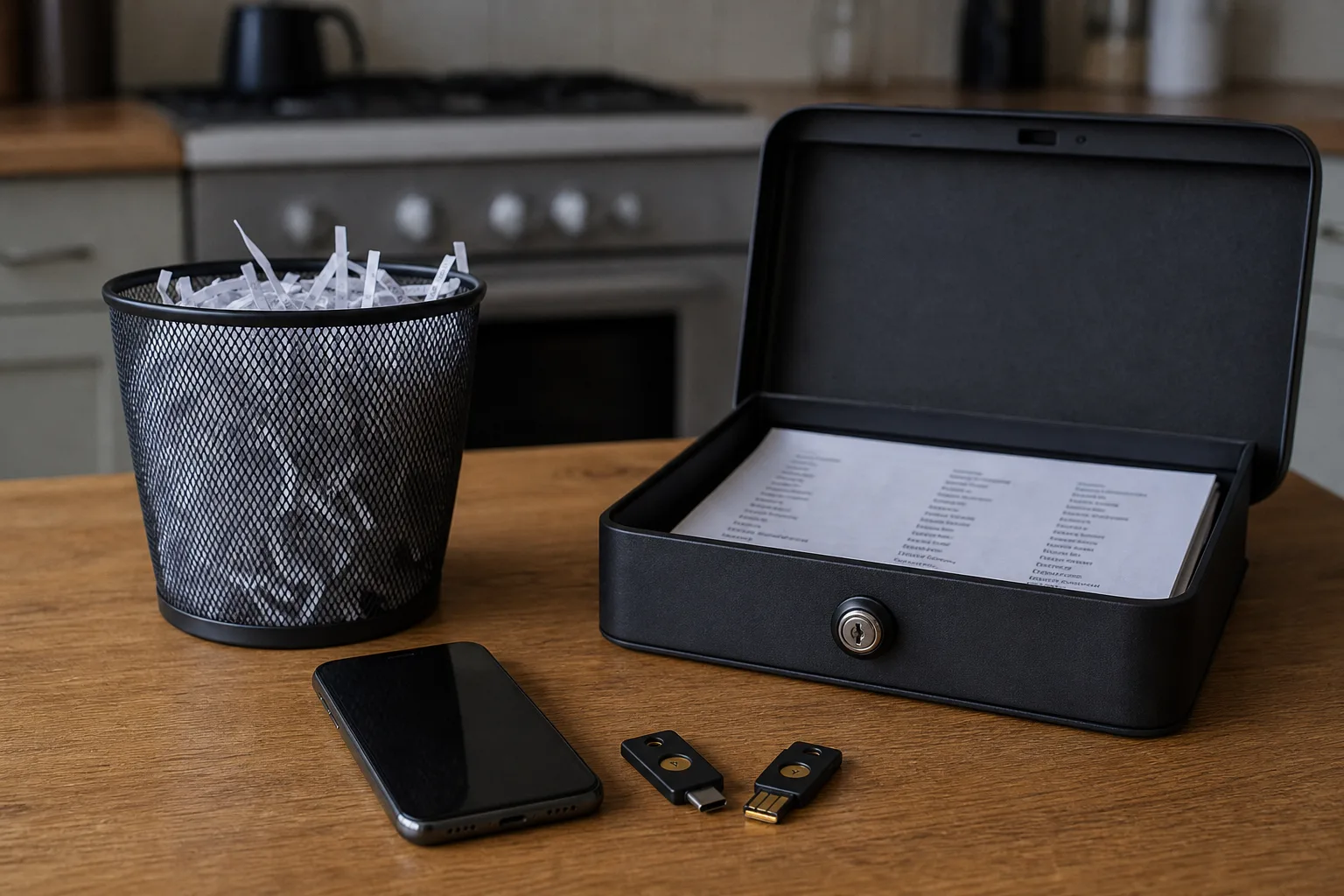
Every credential decision you make gets handed to somebody else eventually. A help desk technician resets it, an executor tries to get past it, a fraud analyst at a bank decides whether the login that just happened was you, and a recycler at a county depot takes in the phone that still holds the session token. None of those people were in the room when you chose between a browser vault, a paid manager, a hardware key or a sheet of paper in a drawer. All of them inherit the consequences, and what they are permitted to do about it changes depending on where you and they happen to be.
What each option hands to the person on the other end of the reset line
A browser vault costs the help desk almost nothing until the device dies, at which point recovery runs through whichever account holds the sync, and that account is usually secured by the same password the user just lost. A dedicated manager moves the problem to one master secret and a recovery kit, which is a printed artifact that the user either stored properly or shredded in a panic two years ago. Passkeys change the shape of the call entirely: there is nothing to read aloud, nothing to type, and the technician is instead confirming which devices are enrolled. Paper records are the fastest to recover and the easiest to photograph.
Technicians notice a second difference that rarely appears in the comparison charts. With a vault or a manager, a reset is a single event with a clear end. With passkeys and hardware keys, recovery is an inventory problem, because the question is not what the secret was but which physical objects still exist and where they are. That favors households that can name their devices without hunting. The National Institute of Standards and Technology is responsible for the federal digital identity guidelines that most of these recovery designs are measured against, and the direction of that work has been toward fewer forced changes and stronger device-bound credentials.
The executor's problem, and the state statute that decides it
Estate attorneys deal with the version of this that cannot be fixed by calling support. Nearly every state has adopted some form of the revised uniform act on fiduciary access to digital assets, but adoption is not uniform in practice, and the details that matter are local: whether the will has to name digital assets explicitly, whether a provider's own in-account legacy tool overrides the will, and how much a fiduciary can see beyond a catalog of account names. Two families with identical setups in neighboring states can get different answers from the same company's legal department.
That shifts which option is the sensible one. A shared manager vault with an emergency access delegate tends to be the cleanest path, because the delegate is exercising an access right the account owner already granted rather than asking a provider to grant one after a death. Passkeys are excellent for the living owner and awkward for the estate, since the credential is bound to hardware that may be locked, wiped or already gone. A written record in a fireproof box, listing accounts rather than passwords, remains the thing probate attorneys actually ask for first.
What the choice leaves behind, and what the county will not take
Follow the discards and the comparison gets more concrete. A household that moves to passkeys accumulates hardware: old phones, a retired tablet, two security keys, a laptop that was the backup authenticator. A household on a paper system accumulates paper, and the sheets are worse than they look, because a drawer of superseded printouts still lists usernames, security answers and the shape of a naming scheme. A manager leaves the least physical residue and the most account residue, which is dozens of logins nobody has used in years but which still exist to be breached.
Disposal is where local rule bites hardest. Many states ban covered electronics from household trash outright and route them through manufacturer-funded takeback programs, while others leave it to the county, and a few leave it to whichever hauler holds the contract. Some depots will accept a phone but not a loose lithium battery, some require the device be handed to staff rather than dropped in a bin, and some offer witnessed hard drive shredding on specific days only. The practical move is to factory reset and remove the device from your account list before it ever leaves the house, then let the depot handle the metal.
Paper has its own rule set. Cross-cut shredding is the floor, not the ceiling, and shredded paper is accepted in curbside recycling in some programs and rejected in others because the fiber length is too short for the mill. Where it is rejected, the bag goes in the trash or into a compost stream if the jurisdiction runs one. None of this is difficult, but it is the part of a password migration that people schedule last and then improvise, which is how a stack of old recovery sheets ends up in an unsecured bin behind a building.
The fraud desk, the breach letter, and the rules that stop at a state line
Fraud analysts read your choice as a pattern. Logins from a manager tend to be fast, correctly typed and consistent, and a sudden slow, error-laden entry reads as trouble. Passkey and hardware key logins are close to unambiguous. Reused passwords surface on the other side, when an analyst sees a credential stuffing run hitting an account that never changed after an earlier breach elsewhere.
Breach notification is state law, and the differences are real: what counts as personal information, how fast notice must go out, whether the state attorney general gets a copy, and whether credit monitoring is offered as a matter of policy or required. Several states also give residents standing statutory rights to free credit freezes and to demand deletion. The upshot for the reader comparing options is that the notice you receive, and the remedies attached to it, depend on your residence rather than on where the company sits.
Pick the option that the next person can work with. A manager with a named emergency contact, a short written catalog of accounts kept somewhere fireproof, passkeys on the handful of accounts that carry real money, and a standing habit of wiping and properly routing every device before it leaves the house covers the reset call, the probate file and the depot in one pass.