Re:Legal
Your First Dispute, and the Day Continuing Costs More Than the Gap Between You
Dated4 min read
How settlement became the default outcome in consumer and contractor disputes, and how a first-timer can tell when the arithmetic has turned.
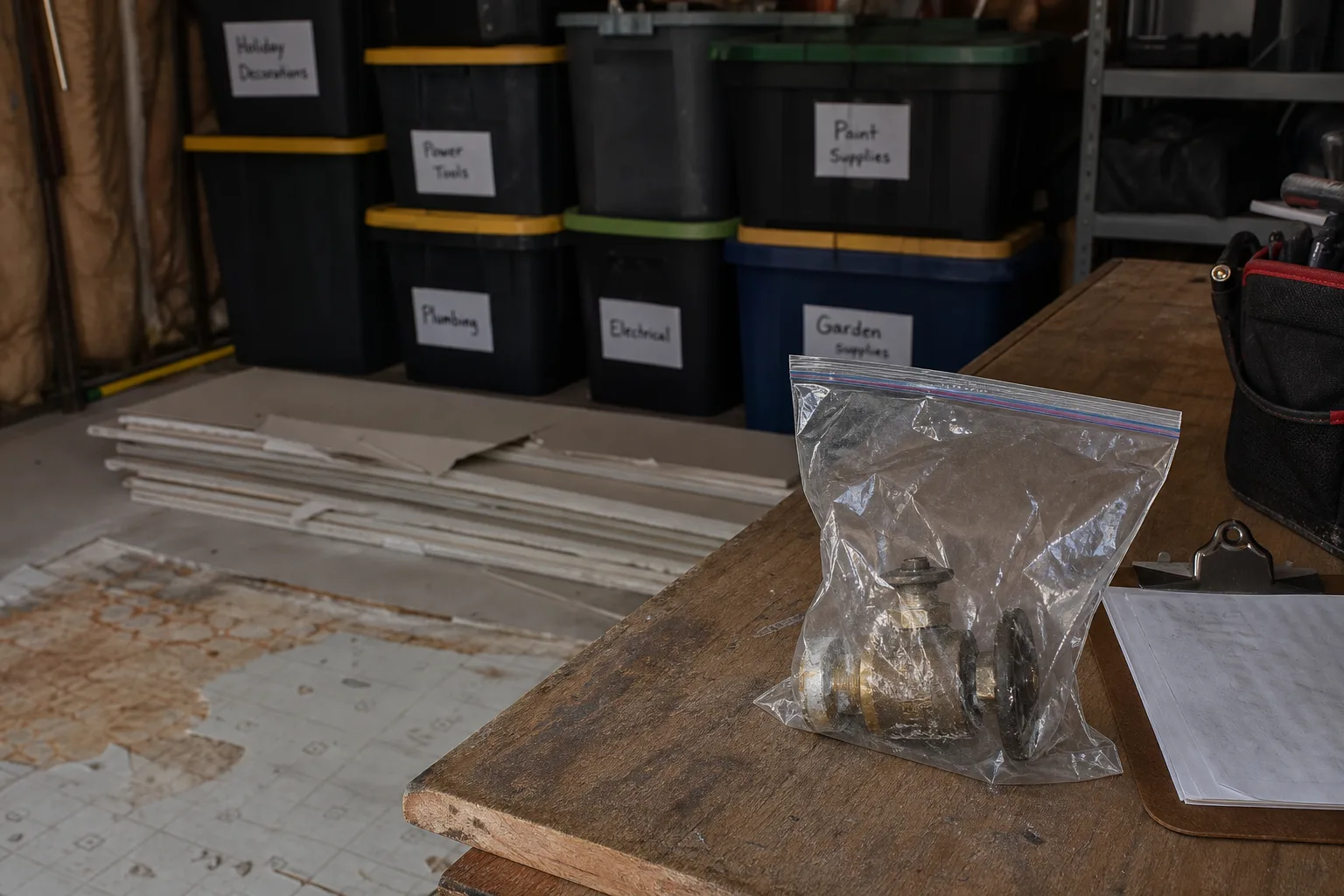
The first thing a dispute produces is debris. Lifted tile stacked against the garage wall, a section of subfloor cut out and bagged, the failed valve in a freezer bag with a date written on it in marker. A homeowner in their first real argument with a contractor or an insurer usually wants that material gone, because it smells and it takes up the space a car used to occupy. Keeping it is the first cost of the fight, and it is the one nobody budgets for. Everything that follows runs on the same arithmetic.
How settlement became the ordinary ending
Civil courts in this country were never built to try the volume of disagreements people actually have, and the system adapted by making trial the exception rather than the destination. Scheduling orders push parties into mediation before a judge will hear much of anything. Small claims divisions were created to strip out lawyers and formal evidence rules for amounts under a state ceiling. Consumer contracts, remodeling agreements, and service terms have for decades carried arbitration and pre-suit notice clauses that route a complaint somewhere other than a courtroom. The result is a culture where the question is rarely whether you settle, only when and on what terms.
Insurers arrived at the same place by a different road. Claim handling built around reserves, adjuster authority limits, and internal review means a file has a number attached to it early, and that number moves in response to documentation rather than to indignation. Contractors operate similarly once a warranty or a bond is involved. A first-timer who expects a hearing, a verdict, and a vindication is working from a model that most disputes abandoned long ago. Understanding that early changes what you collect, what you keep, and how you write the first letter.
What the evidence pile actually costs to hold
Physical proof is expensive in ways that are invisible until you are storing it. Wet carpet pad and cut drywall start to smell within days, and a sealed tote slows that without stopping it. Cabinet doors with the wrong finish occupy a bay. A failed water heater weighs enough that nobody is moving it alone, and the plumber who replaced it will charge to haul the old one if you later decide you no longer need it. Then there is the material you cannot simply set at the curb, which is a category larger than most people expect.
Demolition from a house built before the late seventies can carry lead paint residue, and older resilient flooring and pipe insulation can carry asbestos, both of which the Environmental Protection Agency oversees for handling and disposal. Transfer stations turn that load away, and a licensed abatement outfit charges by the job rather than by the yard. None of this is a reason to throw evidence out. It is a reason to photograph exhaustively, to take samples rather than keep the whole floor, and to ask your adjuster or attorney in writing which items genuinely need to survive. A disciplined pile of six labeled things beats a garage full of rot.
The point where the curve turns
Every dispute has a gap, which is the distance between the best offer on the table and the amount you believe you are owed. It also has a burn rate: billable hours, an engineer's inspection, storage, time off work, and the second contractor who will not start until the first one's claim is resolved. The moment to settle arrives when the cost of closing the gap exceeds the gap itself, and that moment arrives sooner than first-timers imagine, because they count only the legal fees. A thousand-dollar disagreement with a four-hundred-dollar monthly carrying cost is already lost in the third month.
The second signal is informational. Early in a dispute, every week brings something new: a moisture reading, a manufacturer's bulletin, a photograph from the framing stage that someone finally found. Later, weeks pass and nothing changes except the dates on the correspondence. When new information stops arriving, the valuation is as good as it is going to get, and further waiting is just paying rent on a position. Experienced parties watch for that flattening. It is the clearest practical cue available to someone handling this for the first time.
Reading the first number you are offered
An opening offer is a test, not an appraisal, and it is usually built from what the other side thinks you can document rather than what you lost. The useful response is not a counter-number pulled from feeling, but a short written itemization: the estimate, the invoice, the photographs, the dates. Numbers that trace to a document move. Numbers that trace to frustration do not. First-timers often undervalue the parts they can prove cleanly, such as disposal fees and the two days of hotel, and overvalue the parts that depend on someone believing them.
Read the release before the amount. A settlement normally ends every claim arising from the same facts, including ones you have not discovered, which matters when hidden water damage or a structural issue might surface in a year. Ask whether the release is limited to the described work, whether a warranty survives it, and whether payment is due on signature or on completion of a repair. Those terms are negotiable more often than the dollar figure, and for a homeowner they are frequently worth more. Getting them right is what makes a modest number a good outcome.
The garage empties out at the end, which is the part nobody pictures while the argument is live. Schedule the haul-away for the week after the check clears, keep the labeled samples and the photographs in a single file, and write down what the whole thing cost you to carry. That figure is the one you will use the next time someone hands you a contract with a notice clause in it, and it will make you faster and calmer than you were.